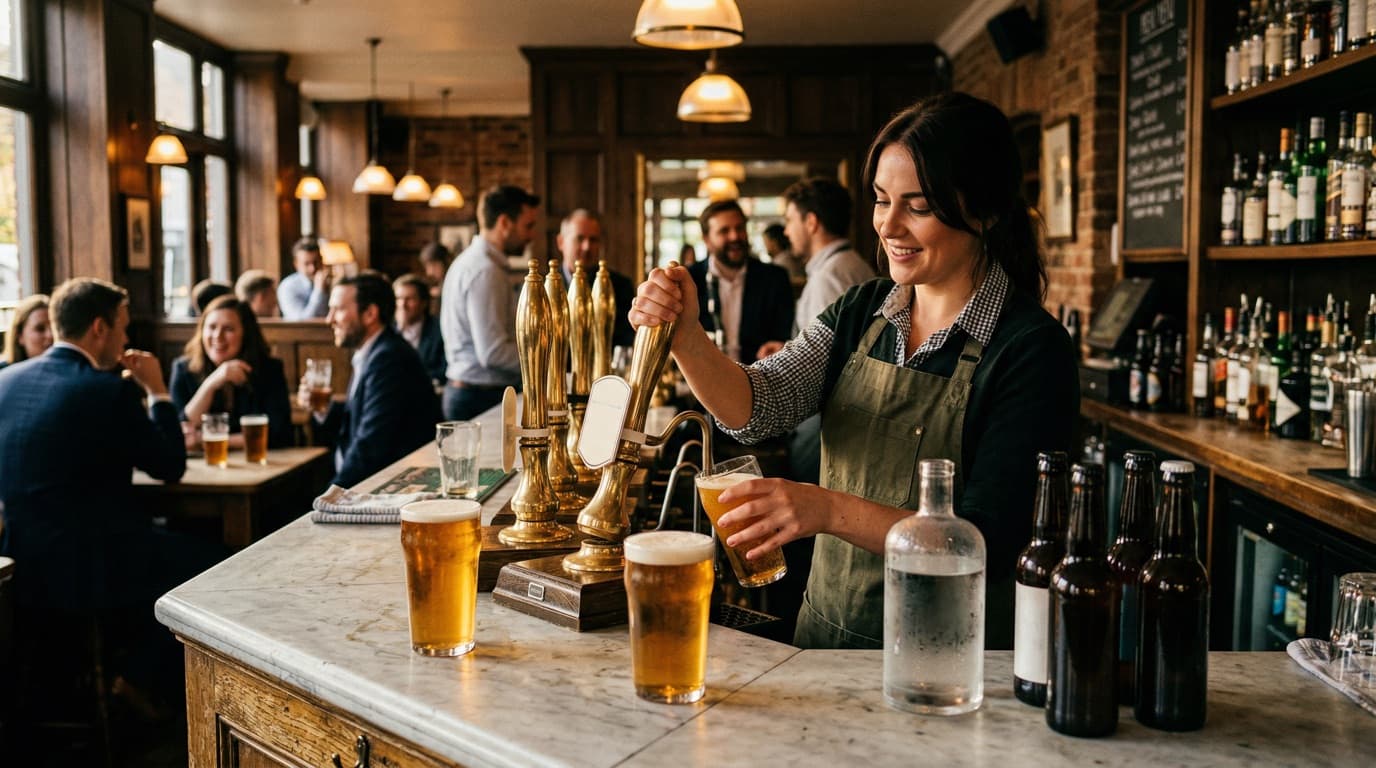
10 years ago, asking for an alcohol-free drink at a UK pub meant a shrug, a warm bottle of Beck's Blue, and the immortal suggestion of lime and soda. Walk into a decent pub in 2026 and there's a Guinness 0.0 on draught, a proper AF G&T made with Seedlip and a decent tonic, and a pint of Lucky Saint to go with your burger. The bar staff don't blink.
That's the story. UK pubs have quietly gone from hostile to non-drinkers to genuinely interesting for them, and it has happened faster than most people noticed.
Why We're Reaching for the AF Pump
The shift isn't driven by teetotallers. It's driven by drinkers. KAM Insight's 2025 research with Lucky Saint found 76% of UK adults who drink alcohol are actively moderating their intake, and 58% say there's less stigma around ordering alcohol-free than there used to be. One in three pub-goers now alternates between alcoholic and alcohol-free drinks in the same outing, a behaviour the trade has taken to calling zebra-striping.
Why? Some of it is the obvious stuff: feeling better in the morning, getting more out of a Sunday, not driving home worried. Some of it is the slow realisation that two pints into an evening you're not really tasting the third anyway. Some of it is just that the AF options have got good enough to actually want.
“The shift isn't driven by teetotallers. It's driven by drinkers”
Whatever the reason, the AF drinker is no longer the odd one out at the bar.
What's Actually on the Bar Now
- Low and no beer is now the fastest growing beer category in the UK, BBPA (January 2024)
- Heineken 0.0 hits 1,000 draught taps in UK, Morning Advertiser (April 2025)
- Heineken 0.0 aims for 2,000 draught taps by March, Morning Advertiser (November 2025)
- Diageo to expand draught Guinness 0.0 trials, Morning Advertiser (September 2024)
- Lucky Saint on why pubs should expand alcohol-free beer range, Morning Advertiser (July 2024)
As of early 2024, 87% of UK pubs stocked at least one AF option. That figure was unimaginable a decade ago. But the headline isn't the share, it's the variety.
On draught: Heineken 0.0 passed its 1,000th UK tap installation in April 2025, and is targeting 2,000 UK taps during 2026. Guinness 0.0 went onto draught in 2024 and Diageo has been expanding its rollout since. Lucky Saint 0.5 has passed 1,000 draught stockists. Estrella Galicia 0.0 has become a regular sight on the bar across the managed-pub trade.
In bottles and cans: AF pale ales, IPAs, stouts, wheat beers, sours. You won't find all of them in every pub, but in any half-decent independent or gastro pub you'll find at least three styles.
Spirits and cocktails: This is where things have really shifted. A decent pub will now have at least one AF spirit, usually Seedlip, sometimes a Lyre's or a Caleño. That turns into a real G&T, a Negroni-ish thing, or an AF spritz. In London and a handful of bigger venues elsewhere, you'll find dedicated AF cocktail menus.
Wine: Still the laggard. Pubs that take wine seriously will have one or two AF options. Most don't.
The point is that the pub-goer who doesn't want alcohol no longer has to negotiate. They can order a drink, not the absence of a drink.
The Designated Driver Finally Gets Something Good
For decades, the designated driver was the worst-served pub-goer in Britain. A warm coke, or an orange juice if you were lucky. The social geometry of the round didn't really include them. They nursed a soft drink, watched their friends order in pints, and waited.
That's changing, and it's the change that matters most. A driver in 2026 can have a Guinness 0.0 that holds its own next to the regular stuff, a Lucky Saint pulled in a branded glass with a proper head, or an AF G&T that tastes like a G&T, balloon glass and grapefruit slice and all. The round includes them again.
Pub culture is participatory. Being able to participate without alcohol, with a drink that feels like a drink, changes the whole evening.
Lucky Saint's own research with KAM put the lost opportunity here at £800 million a year, money that customers would have spent on something decent if something decent were available. The decent is now showing up.
Alcohol-Free Drinks in UK Pubs: Where It Works and Where It Doesn't
Chain pubs (Wetherspoons, Greene King, Stonegate): Reliable. Greene King reported a 238% jump in draught AF sales across its 1,600 managed houses comparing January 2024 with January 2025. You'll get two to four bottled options and increasingly a draught Heineken 0.0 or Guinness 0.0. The range is limited but the staff know what they're pouring.
Gastro pubs and managed pubs: This is the sweet spot. Fuller's, Young's, and a long tail of well-run independents have invested seriously. Expect a Lucky Saint or Estrella Galicia 0.0 on draught, a decent AF G&T, sometimes a wine option.
Independent pubs: A lottery. Some are brilliant. Some still have nothing better than a warm Beck's Blue. Worth checking a menu online before you commit your Saturday to one.
Country pubs: Catching up faster than you might expect. Brands like Days Brewing have expanded rapidly through nationwide listings, and rural landlords have been adding bottled AF lines as customers ask for them. Don't write a remote pub off without asking.
The Frustrations That Remain
AF drinks in pubs still cost almost as much as their alcoholic equivalents. That's defensible (the brewing process is largely identical and lower duty doesn't always translate to lower retail) but it grates.
Draught variety is still limited. As of early 2024, 8% of UK pubs served AF beer on draught, up from 2% in 2019. That's a fourfold rise but still leaves the vast majority of pubs without an AF tap line. The craft AF range that has grown so quickly in bottles hasn't reached the pumps yet.
And the experience is still inconsistent. One pub will have three AF options and a clued-up bartender. The next will hand you a warm bottle of something forgettable.
Where It's Heading
The big breweries are committed. Heineken's EverGreen 2030 strategy names low and no-alcohol as one of four key segments. Diageo has continued to expand its Guinness 0.0 draught rollout. The UK government has committed under its 10-Year Health Plan to explore raising the alcohol-free labelling threshold to 0.5% ABV, which would bring the UK into line with most other major markets.
The trajectory points to a pub where ordering an AF beer, an AF G&T or an AF cocktail feels as routine as ordering a lime and soda used to feel apologetic.
How to Ask, What to Order
Ask specifically. "What alcohol-free beers do you have?" beats "Do you have anything non-alcoholic?" One question gets you the beer list. The other gets you pointed at the fridge of soft drinks.
Try the G&T. Most decent pubs now keep a Seedlip or equivalent. An AF G&T in a proper glass is the single biggest upgrade on the old coke-with-ice routine.
Check before you go. Wetherspoons, Greene King and Stonegate pubs reliably stock options; their apps and menus often list AF lines.
Give feedback. If your local doesn't stock anything good, tell them you'd buy it if they did. Landlords listen.
The drink in your hand used to be the price of admission to the evening. It still is. The good news is that the drink doesn't have to have alcohol in it anymore.