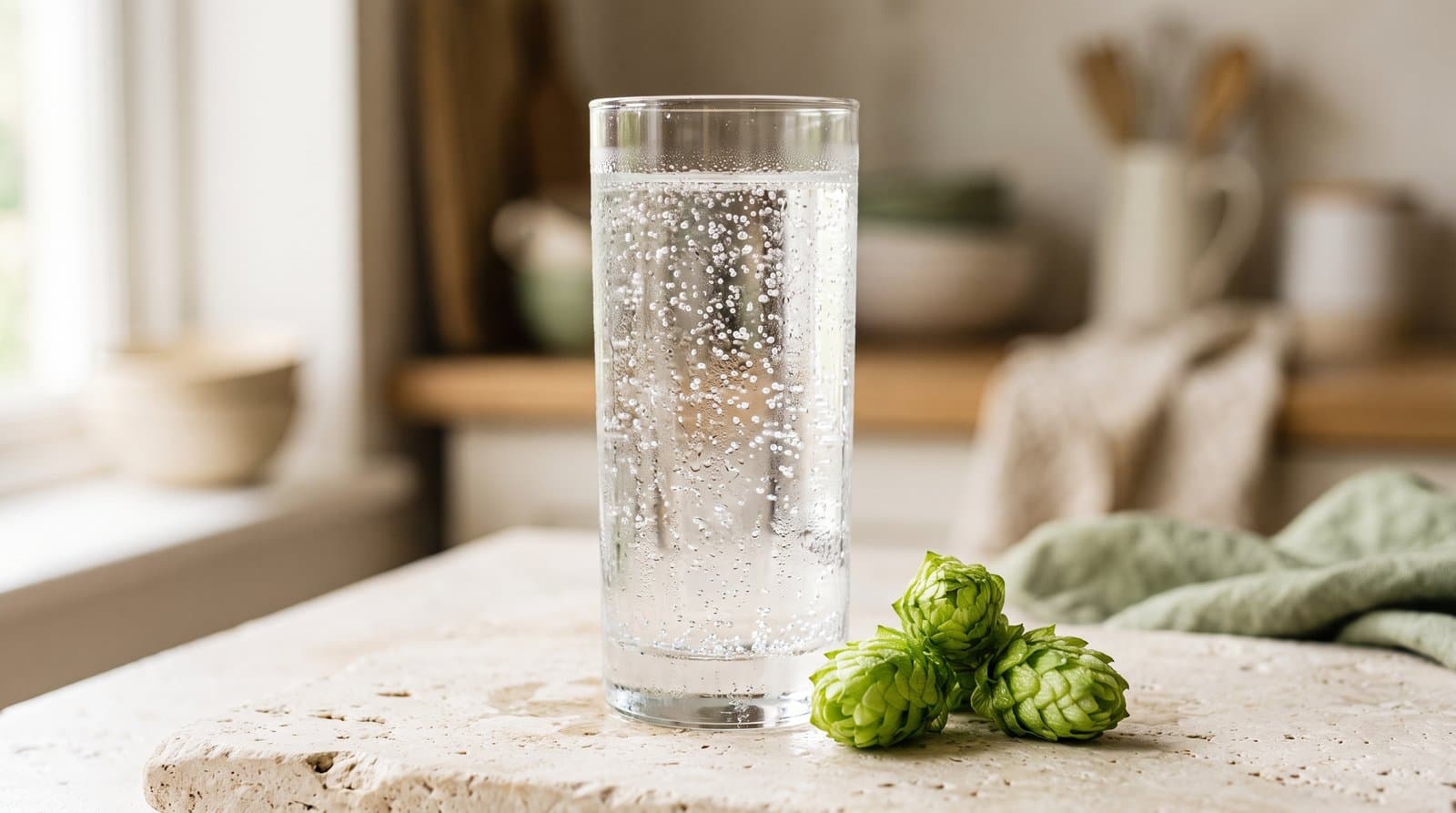
You have worked through the alcohol-free beers. The lagers, the pale ales, the stouts that took three attempts before you liked them. And now there is a can on the shelf that says hop water, sitting right next to them, and nobody has told you what it is.
Short version: non-alcoholic hop water is not beer, and it never set out to be. Worth getting straight before you buy one, because the quickest way to be disappointed by it is to expect a lighter IPA.
What Non-Alcoholic Hop Water Actually Is
The recipe is short enough to say in one breath. Boil water. Add hops, whether whole cones, pellets or extract. Chill it, carbonate it, and add a little citric acid so it keeps on a shelf.
What is missing is the interesting part. No grains of any kind go in. No barley, no wheat, no malt. And with no grains there is nothing for yeast to ferment, so no alcohol is ever produced in the first place.
Some brewers do add a pinch of yeast, which sounds like a contradiction until you look at why. Lagunitas says it adds brewer's yeast to its Hoppy Refresher to biotransform the hops and pull out the aroma compounds. The yeast is there to work on the hops, and with no grain in the vessel there is nothing for it to ferment.
Which brings us to the number that matters if you are avoiding alcohol strictly rather than mostly. Hop water is 0.0% ABV. Alcohol-free beer is allowed up to 0.5%, and plenty of it sits there quite legitimately, a gap we picked apart in the 0.0% versus 0.5% question.
The cleanest way to hold the difference is direction of travel. Alcohol-free beer starts as beer: depending on the method, the alcohol is either stopped before it forms in quantity or taken back out afterwards, and we went through the several ways that is done. Hop water skips all of it. There was nothing to stop and nothing to remove.
Same shelf. Opposite mechanism.
What It Tastes Like, and What It Doesn't
Hops do two jobs. Bitterness comes from iso-alpha acids, which are what create beer's bitterness in the first place. Aroma comes from a different set of compounds, the ones brewers group as essential oils. Neither depends on the grain, so both carry into hop water: if you like Citra you get Citra, which the UK hop merchant Charles Faram describes as abundant tropical fruit, typically grapefruit, mango and peach.
Now the part nobody puts on the can.
Malt was doing more work than you probably credited it with. The maltster Crisp Malt describes dextrin malt as enhancing body, mouthfeel and foam stability while contributing a clean, light sweetness. Notice how much of your idea of "beer" sits inside that list. Hop water has no grains, so it has none of it.
That absence forces a design decision. Bitterness is measured in IBUs, international bitterness units, and hop water carries no real amount of residual sugar or alcohol to balance it against. So Brew Your Own tells anyone brewing hop water to keep it between 8 and 12 IBUs. For a sense of what that means, BrewDog gives Nanny State, its alcohol-free hoppy ale, as 50.
That is four to six times the bitterness, with the malt body to carry it. Hop water is a much lighter and much drier drink than the alcohol-free hoppy ale you have been buying. Brew Your Own puts it more bluntly than any brand will.
I am not going to say hop water is a beer replacement; it's definitely not. But if you enjoy hops and sparkling water, chances are you will like hop water.
The Calorie Question, and Where It Genuinely Wins
- Hop Water, Track Brewing Company
- What the hell is Holy Hop Water?, Northern Monk
- Unfiltered Lager Bottles, Lucky Saint
- Frequently Asked Questions, Guinness GB
- Heineken 0.0: great taste, all natural, only 69 calories and zero alcohol, The HEINEKEN Company (May 2017)
- Heineken 0.0 Ultimate unveils first zero alcohol, zero calorie, and zero sugar brew, The HEINEKEN Company (March 2026)
- Sparkling Hop Water, Abbeydale Brewery
- Hop Water, Buxton Brewery
This is where hop water stops being merely different. Track Brewing describes its hop water as zero sugar, zero calories and zero alcohol; Northern Monk says Holy Hop Water has no sugars, no caffeine, no alcohol and no calories.
The beers are harder to compare than they look, because the brands publish on different servings. Lucky Saint lists its Unfiltered Lager at 53 kcal per 330ml (11.2 fl oz) bottle. Guinness gives 0.0 as 17 kcal per 100ml (3.4 fl oz). Heineken said in 2017 that its 0.0 carries 69 calories per 33cl bottle.
Put on the same 330ml serving, Guinness 0.0 works out at roughly 56 kcal, so it is marginally above Lucky Saint rather than a third of it.
All three land between 50 and 70 calories a bottle. A zero-calorie hop water is the outlier.
**0 kcal**
Track and Northern Monk hop water, per their own descriptions
53 kcal
Lucky Saint Unfiltered Lager, per 330ml (11.2 fl oz) bottle
56 kcal
Guinness 0.0, per 330ml (11.2 fl oz), from its published 17 kcal per 100ml
69 kcal
Heineken 0.0, per 33cl (11.2 fl oz) bottle
Two honest qualifications, though. Alcohol-free beer has stopped conceding the point: in March 2026 Heineken launched 0.0 Ultimate, which it describes as zero alcohol, zero calories and zero sugar, currently in the US and Poland and piloting elsewhere. And hop water is not uniform either. Abbeydale calls its own naturally low in sugar and carbohydrates, which is not the same as free of them, and publishes no calorie figure. Buxton publishes none either.
Worth noting though that none of these hop water pages carry a nutrition panel. They are brewery product descriptions, written by people who know exactly what goes into their own cans, and there is no particular reason to doubt them. They just are not the standardised declaration that lets you line two drinks up side by side.
Is Non-Alcoholic Hop Water Gluten-Free?
- Frequently Asked Questions, HOP WTR
- Hop Water, Buxton Brewery
- Gluten Free range, Abbeydale Brewery
- What alcohol can be included on a gluten free diet?, Coeliac UK
- Unfiltered Lager Bottles, Lucky Saint
- Non-alcoholic beer and hop water, Sierra Nevada Brewing Co.
- FAQ About our Hop Tea & Hop Water, Hoplark
- Gluten-free in the brewery: what, why, and how?, Colorado Brewers Guild
No grains go into hop water, so there is no gluten in the recipe. Several brands say so outright: HOP WTR's FAQ answers with "Yes, all of our products are gluten free!", Buxton's product page asks "Gluten free?" and answers "Yes", and Abbeydale lists its Nelson Sauvin hop water on the brewery's own gluten free range. Northern Monk and Track say nothing either way, and silence is not a claim.
Compare that with what you would be drinking otherwise. Coeliac UK is direct: beers, lagers, stouts and ales contain varying amounts of gluten and are not suitable for a gluten free diet. Taking the alcohol out does not change it. Lucky Saint's alcohol-free lager carries the declaration "Contains barley (gluten)", and Sierra Nevada answers the same question about its alcohol-free Trail Pass with a flat no. That is a real difference, and it is a difference in what is in the can rather than a health claim.
Here is the part the brands mostly do not volunteer, and one of them does. Most of the producers named here are breweries, which raises an obvious question about shared equipment. Hoplark says what that means for its own products: its facility is not a dedicated gluten-free facility, it tests every batch, and it recommends anyone with a gluten sensitivity check with their doctor. Brewing-industry guidance makes the same point, advising that hoses, gaskets, kegs and tap lines would ideally not be shared between gluten-containing and gluten-free production.
A recipe with no grain in it is not the same as a production line with no grain in it. If you are coeliac rather than avoiding gluten by preference, check the individual can.
What It Won't Do For You
- Pharmacological profile of xanthohumol, a prenylated flavonoid from hops, Molecules 2015
- The sedative effect of non-alcoholic beer in healthy female nurses, PLoS One 2012
- Frequently Asked Questions, HOP WTR
- Hop water to fill wellness niche in nonalcoholic beer, Food Dive (Dec 2025)
- Constellation Brands buys Hopwtr, expands nonalcoholic portfolio, Food Dive (March 2026)
Two things get claimed for hop water that the evidence does not support.
The first is health. Hops carry a compound called xanthohumol, and it is the one the wellness end of this category leans on. A 2015 pharmacological review looked at how much of it you would actually be drinking: commercial beers contain less than 0.2 mg per litre, which the review calls not enough to really be beneficial to health, and it concludes that pharmacologically relevant concentrations cannot be reached by drinking regular beer.
That finding is about beer, and beer is the drink the measurement exists for. Nobody appears to have published an equivalent figure for hop water, so there is nothing to point to that establishes a useful dose in a can.
There is one human trial people reach for, and it is worth saying what it tested. In 2012 researchers gave 17 healthy female nurses on rotating or night shifts 330ml (11.2 fl oz) of alcohol-free beer with supper, and sleep latency fell to 12.01 minutes against 20.50 in the control group. That is a real finding about 17 people drinking alcohol-free beer. It does not become a finding about hop water by being quoted next to a can of it.
Where a brand does promise something functional, look at what is doing the work. HOP WTR says each can contains L-theanine to support a relaxed, alert state, reishi extract to support immune health and the body's response to everyday stress, and vitamin C. Those are ingredients added to the can, not properties of hops.
So: no established health benefit from the hops at these doses. What is true is simpler. There is no alcohol in it. Not 0.5%, not 0.05%, none.
The second claim worth deflating is that hop water is the next big thing. The category is worth around $28.5 million in US sales, and in the 52 weeks to 25 October 2025 those sales fell 7.3% while alcohol-free beer grew 18%. Sierra Nevada's hop water line is about 1% of that brewer's business.
The big companies have not walked away, mind: Constellation Brands bought HOP WTR outright in March 2026. So the picture in the US is a small category that shrank over a year in which the thing next to it on the shelf grew strongly, while still attracting a major buyer.
Where to Find One
In the UK, several breweries make one. Northern Monk in Leeds reckons its Holy Hop Water was the first in the country and sells it direct. Track in Manchester dry-hops its version with Citra. Abbeydale in Sheffield calls its own not beer, but the very finest Yorkshire water infused with hops. Buxton makes one in the Peak District. In the US the names are bigger: HOP WTR, Lagunitas Hoppy Refresher, Sierra Nevada's Hop Splash, Hoplark.
Do not assume the American brands ship to you: HOP WTR states plainly that it does not ship internationally, and the others publish their own policies. And be prepared for gaps closer to home. In September 2026 one UK retailer listed Northern Monk's Sabro hop water as sold out, which is one shop on one day and no basis for anything dramatic. The dependable route is ordering direct from a brewery.
So, Is It Worth Trying?
If what you like about an alcohol-free IPA is the hop character, the citrus and the bitterness at the back, then yes. You get that on a lighter, drier base, at 0.0% rather than 0.5%, and with no gluten in the recipe.
If what you like is the body, the malt sweetness, the sense of drinking a beer, then no, and no amount of good hop water will change it. Stay with the alcohol-free beers. They are doing a different job.
Hop water is not a replacement for anything. It is a hop-flavoured sparkling water, which sounds like faint praise until you notice how few drinks there are for someone who has stopped drinking and is bored of sweetness. Buy one can before you buy twelve.