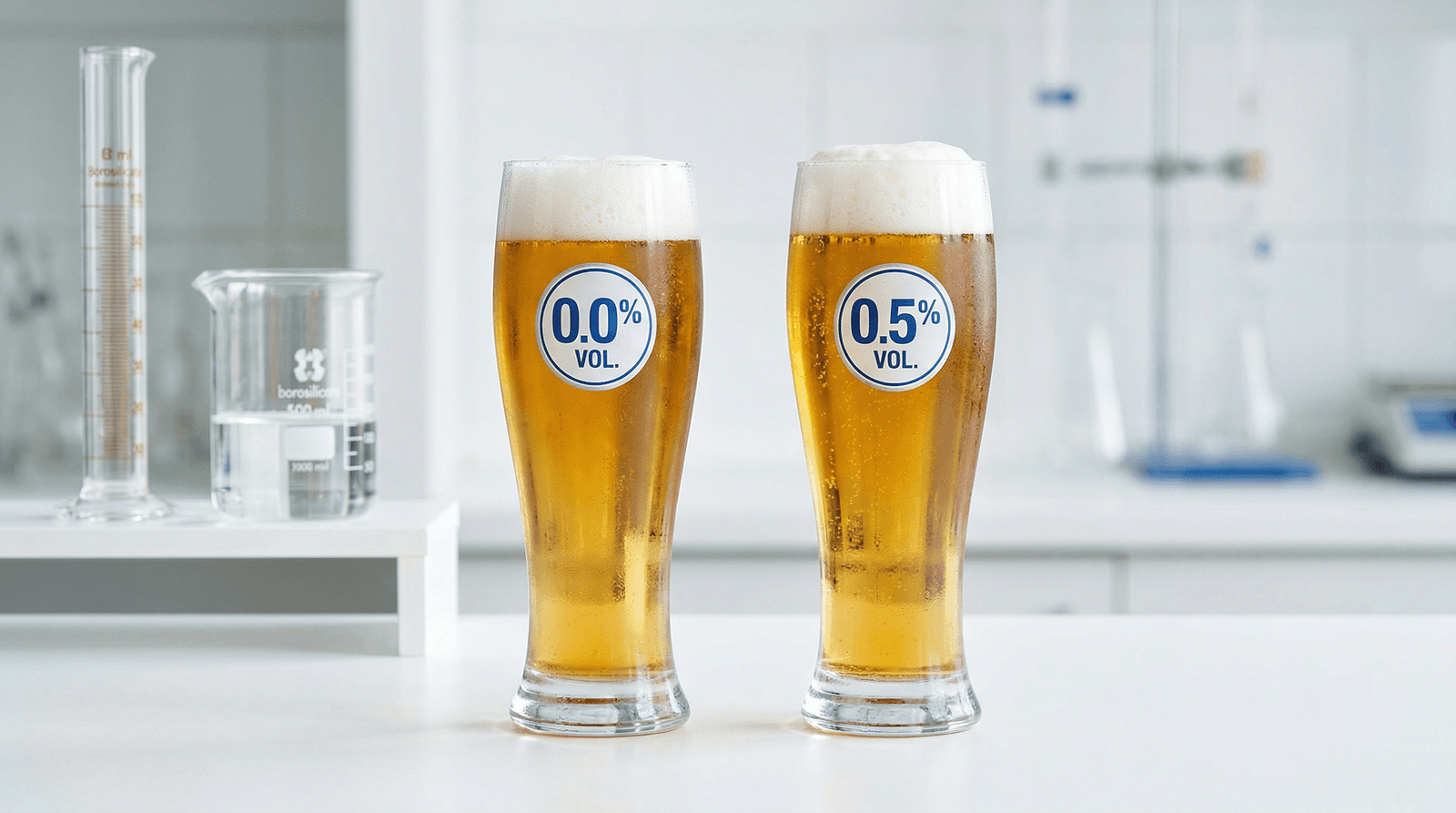
You pick up a can labelled “alcohol-free” and spot “0.5% ABV” on the back. Hang on. Alcohol-free beer that contains alcohol? That sounds like a contradiction. Maybe even a con.
It’s not. But the labelling is confusing, the regulations are a mess, and most people have never been given a straight answer. So is 0.5% beer alcohol-free or not? Here’s the straight answer.
**2.2 g**
Alcohol in a pint of 0.5% beer
0.28 units
Same pint, in UK alcohol units
7 g/hr
Liver alcohol elimination rate
~20 min
Time to clear one 0.5% pint
1.28 g/100g
Trace alcohol in a fresh-baked burger bun
0.04 g/100g
Trace alcohol in a very ripe banana
““A burger bun has around three times the alcohol per gram of a 0.5% beer.””
What the law actually says
Here’s where alcohol-free beer UK law gets confusing. Government guidance from the Department of Health recommends that ‘alcohol-free’ should mean no more than 0.05% ABV. ‘De-alcoholised’ covers up to 0.5% ABV, while the low alcohol beer definition stretches to 1.2% ABV. These labels were set decades ago and are now out of step with virtually every other major market.
But this guidance is voluntary, not legislation. The Licensing Act 2003 tells a different story: under section 191(1)(a), a drink isn’t legally alcohol unless it exceeds 0.5% ABV at the point of sale. By statute, a 0.5% beer is not alcohol at all.
In the EU, the US, Germany, Australia, and most of the rest of the world, beers up to 0.5% ABV can be labelled alcohol-free. The UK’s voluntary guidance is the outlier, not the standard. A beer legally sold as “alcohol-free” in Berlin or New York has to be labelled “de-alcoholised” in Britain under the guidance, even though it’s the same liquid and UK law doesn’t consider it alcohol.
The UK government recognised this problem and ran a consultation in late 2023 on raising the guidance threshold to 0.5%. That consultation closed in November 2023 and has not yet had a formal response.
The new government’s 10 Year Health Plan for England (July 2025) committed to consulting on raising the alcohol-free labelling threshold to 0.5% ABV and supporting the no- and low-alcohol market. The Department of Health and Social Care has since confirmed it is working towards opening a fresh consultation on raising the alcohol-free threshold to 0.5%, targeted for late 2026. For now, the 0.05% guidance is still the official line.
At Practically Clear, we define alcohol-free as 0.5% ABV or below, matching the legal threshold and the international consensus.
The science: your body barely notices
So how much alcohol is actually in AF beer? A pint of 0.5% beer contains about 2.2 grams of alcohol, or 0.28 units. For context, a standard pint of 5% beer contains 2.8 units, ten times as much.
Your liver processes roughly 7 grams of alcohol per hour, about one standard drink. That means it clears the alcohol from a 0.5% pint in around 20 minutes. You physically cannot drink 0.5% beer fast enough to build up alcohol in your system. Your body neutralises it faster than it arrives.
This isn’t theoretical. A 2012 forensic study had 78 participants drink 1.5 litres of 0.41% beer within one hour. Of the 67 who produced usable results, only 20 showed any detectable blood alcohol at all. The highest concentration recorded was a barely-detectable trace, well below the threshold for any measurable impairment.
For comparison, fresh-baked enriched rolls like burger buns and sweet milk rolls can contain 1.2 to 1.3 grams of ethanol per 100 grams. Most other breads sit lower, around 0.1 to 0.3 grams. A couple of burger buns adds up to roughly the alcohol in a 0.5% pint. A handful of ripe bananas adds another small trace. Nobody worries about getting drunk on a ham sandwich.
Can you drive after a 0.5% beer?
Yes. The UK drink-drive limit is 80mg of alcohol per 100ml of blood in England, Wales, and Northern Ireland (50mg in Scotland). You would need to drink dozens of pints of 0.5% beer in rapid succession to approach these limits, and your liver would be clearing it the entire time.
There is no legal issue with drinking 0.5% beer and driving. There is no practical issue either, since the alcohol doesn’t accumulate in your bloodstream at normal consumption rates.
One caveat: if a police officer sees you swigging from what looks like a beer can behind the wheel, you might get pulled over. Some AF beer brands now use distinctive packaging to avoid exactly this situation.
The taste trade-off: why 0.5% often wins
Here’s something the 0.0% purists rarely mention: alcohol is a flavour carrier. Even at 0.5%, that tiny amount of ethanol contributes to mouthfeel, aroma, and complexity. Remove it entirely and you often end up with something thinner and less satisfying.
Brewers making 0.5% beers can use traditional fermentation methods, just with modified yeasts or adjusted grain bills that naturally produce less alcohol. The beer is brewed more or less normally and ends up tasting like it.
Hitting true 0.0% usually requires additional processing. Vacuum distillation, reverse osmosis, and other dealcoholisation methods all strip alcohol out after brewing, but they also strip some flavour with it. Brewers then have to reconstruct the taste profile. The best 0.0% beers (Guinness 0.0 being a standout) have cracked this, but it’s technically harder and more expensive.
This is why many of the highest-rated AF beers sit at 0.5% rather than 0.0%. It’s not laziness or corner-cutting. It’s a deliberate choice to preserve flavour.
Who should stick to 0.0%
- NHS - Drinking alcohol while pregnant
- Yokoyama et al. (2026) - Self-help group participation, avoidance of nonalcoholic beer, and nonsmoking predict better drinking outcomes, Alcohol: Clinical and Experimental Research
- Caballeria et al. (2022) - 'Doctor, Can I Drink an Alcohol-Free Beer?' Systematic review, Nutrients
For the vast majority of people, 0.5% beer is functionally identical to 0.0%. But there are groups where 0.0% is the more appropriate choice.
Pregnancy. The NHS advises no alcohol during pregnancy, full stop. While the trace alcohol in a 0.5% beer is comparable to what you’d get from everyday foods like fresh bread or ripe fruit, the official guidance doesn’t carve out exceptions. If you’re pregnant and want to enjoy an AF beer, 0.0% options remove the question entirely. Speak to your midwife if you’re unsure.
Recovery from alcohol dependency. This is where it gets personal. The concern with 0.5% beer in recovery isn’t the alcohol content. It’s the ritual. The taste, the smell, the cold glass in your hand. For some people in recovery, that sensory experience can trigger cravings.
A 2026 study followed 198 men in alcohol-dependence recovery: 51% of those who avoided non-alcoholic beer were still abstinent a year later, compared with only 15% of those who drank it. A 2022 systematic review came to a similar conclusion. Craving and desire to drink can increase with NoLo consumption in people with alcohol use disorder, and the effect is more pronounced in those with more severe dependence.
If you’re in recovery, this is a conversation to have with your support network, not something to decide based on a blog post. Many people in recovery enjoy 0.0% beers without any issues. Others prefer to avoid anything beer-shaped. Both approaches are valid. We cover this in more detail in our guide to AF drinks and recovery.
Religious or personal abstinence. If your commitment is to zero alcohol for faith-based or personal reasons, 0.0% gives you certainty. Worth noting though that you’d need the same commitment to avoid ripe fruit, bread, and apple juice, all of which contain comparable or higher levels of naturally occurring alcohol.
So is 0.5% beer alcohol-free?
For most adults, the difference between 0.0% and 0.5% is a rounding error. Everyday foods like bread, ripe bananas, and apple juice all contain trace alcohol and nobody thinks twice about it. You cannot get drunk on it. You can drive after drinking it. UK law already doesn’t consider it alcohol, and the voluntary guidance is catching up with the rest of the world.
If you want to understand what happens to your body when you switch to alcohol-free, the honest answer is: it doesn’t matter whether your AF beer is 0.0% or 0.5%. The benefits are the same.
Choose 0.5% when you want the best flavour. Choose 0.0% when you need absolute certainty, whether that’s for pregnancy, recovery, or personal conviction. Both are legitimate choices. Neither deserves side-eye.
The label might say 0.5%. Your body says: “That’s a slice of bread.”