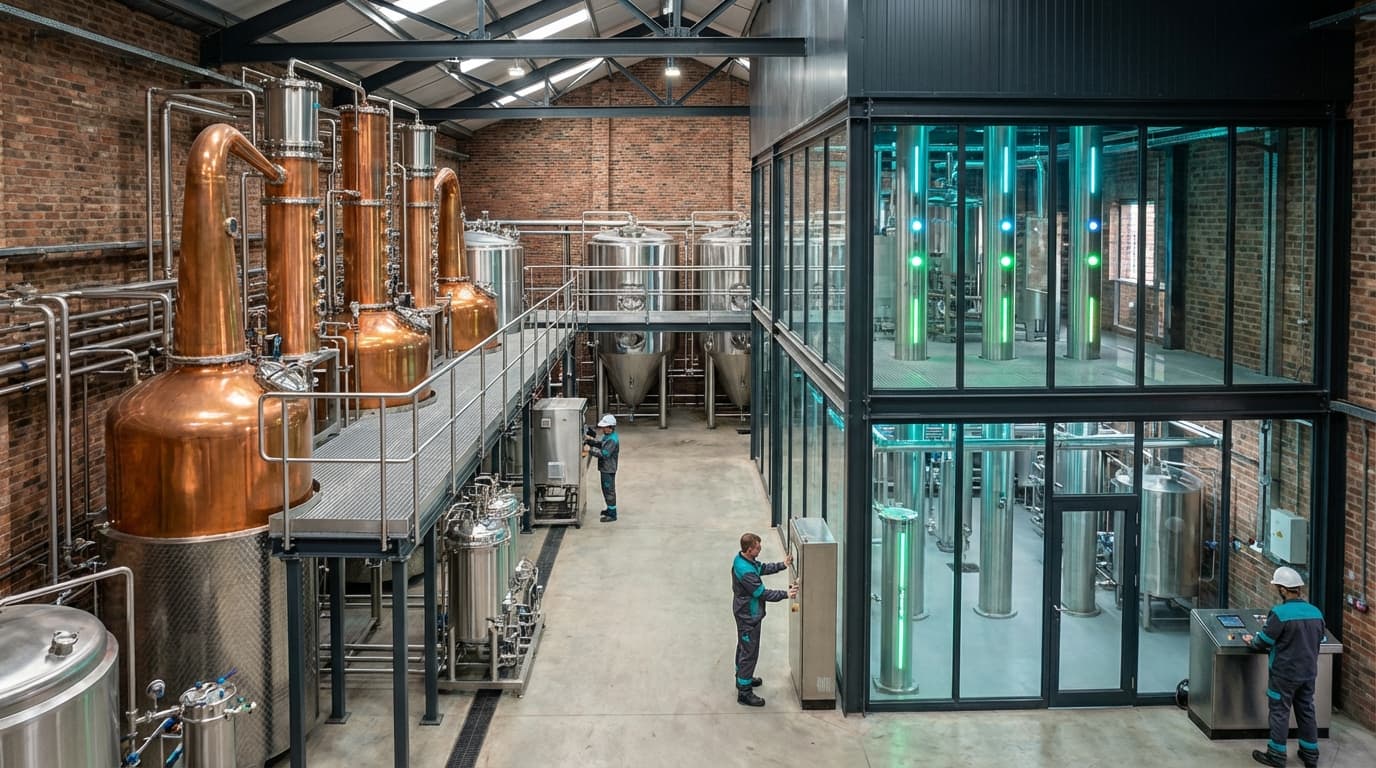
How is alcohol removed from drinks without taking all the flavour with it? You crack open an alcohol-free beer and it tastes like, well, beer. The hops are there. The malt comes through. Everything except the buzz. Somewhere between the brewery and your glass, the alcohol vanished.
The answer involves some genuinely impressive engineering, and not every drink type goes through the same process. Beer, cider and wine each get dealcoholised in different ways. Alcohol-free spirits skip the whole business entirely. And fermented drinks like kombucha have their own story. Here's the complete picture, with a quick map to the deep dive for each drink type.
Why Dealcoholisation Exists
Why make alcoholic drinks just to strip the booze out? Why not skip fermentation entirely?
Because fermentation creates flavour. Hundreds of compounds develop during this process that simply cannot be replicated any other way. Esters that give fruity notes. Aldehydes that add complexity. The toasted, bready characteristics in beer. The tannin structure in wine. The dry crispness of a good cider. Without fermentation, you have grape juice or malt water. With fermentation and careful alcohol removal, you have something that drinks like the real thing.
The challenge is removing ethanol without taking all those delicious compounds with it. That's where the technology comes in, and it changes depending on the drink.
Beer
Beer starts with less alcohol to remove than wine, so brewers have more options. Controlled (arrested) fermentation is one of the most common commercial methods, with reverse osmosis and vacuum distillation also widely used by larger producers. Hoppy alcohol-free beers often taste more convincing than delicate lagers, which is partly why so many of the strongest AF entries in recent years have been IPAs and pale ales.
Full guide: How Is Alcohol Removed From Beer?
Cider
Cider dealcoholisation follows a similar pattern to beer but with apples instead of grain. Producers ferment the apple or pear juice conventionally, then strip out the alcohol afterwards. Because cider's signature notes are fruitier and more delicate than beer's, the same toolkit applies: vacuum distillation and membrane methods are commonly used to preserve the volatile apple esters that give a good cider its bite. The dedicated cider guide covers the specifics.
Full guide: How Is Alcohol Removed From Cider?
Wine
Wine has the hardest job: dropping from 12-15% ABV down to below 0.5% while preserving delicate aromatics, tannin structure and acidity. The spinning cone column (SCC), with a 25-second residence time and low operating temperatures, is widely used for premium AF wine. Vacuum distillation, first used by Carl Jung in Germany in 1907, is also still used widely. Membrane methods play a supporting role for partial reduction.
Full guide: How Is Alcohol Removed From Wine?
Alcohol-Free Spirits: A Different Story
Here's where the story changes completely. Alcohol-free spirits are not dealcoholised. You cannot take a bottle of gin or whisky, strip the alcohol out, and get something recognisably spirit-like at the end. The alcohol is too central to the experience: it carries the flavour, provides the burn, and gives the drink its body. So AF spirit producers build from scratch, using botanicals, extracts, and natural flavours rather than starting with a base spirit. Brands like Seedlip, Lyre's, Everleaf and Ritual Zero Proof all take different routes to the same destination.
Full guide: How Are Alcohol-Free Spirits Made?
“You cannot take a bottle of gin or whisky, strip the alcohol out, and get something recognisably spirit-like at the end”
Drinks That Never Had Alcohol Removed
There's a third category worth knowing about: drinks that are fermented, contain trace alcohol naturally, but are sold as non-alcoholic without necessarily going through a dealcoholisation step.
Kombucha is the best-known example. Because it's fermented (yeast converts sugar from sweetened tea into CO2 and ethanol), it always contains some alcohol. Commercial kombucha sold as non-alcoholic stays below the legal threshold (0.5% ABV in the US, see the labelling section below for UK rules) by controlling fermentation time, temperature and yeast activity.
But not always. Brew Dr., a US kombucha producer, say they use "non-heat distillation" to remove alcohol from their finished kombucha without harming the live cultures. So even kombucha straddles the line between naturally low-alcohol and actively dealcoholised.
Water kefir, kvass, kombucha and some soft drinks that use live cultures all sit in this category: fermentation produces trace ethanol, and commercial versions are kept below the non-alcoholic threshold through a mix of fermentation control and, occasionally, post-fermentation removal. The wider universe of AF drinks beyond the main aisle includes several options here.
UK and US labelling thresholds
Worth knowing what "alcohol-free" actually means on a label:
- UK (current): "alcohol-free" = up to 0.05% ABV; "de-alcoholised" = up to 0.5% ABV; "low alcohol" = up to 1.2% ABV
- US: "non-alcoholic" malt beverages = up to 0.5% ABV (per TTB / 27 CFR 7.65)
- UK (status): the 2023 DHSC consultation proposed raising "alcohol-free" to 0.5% to align with the US and most of Europe, but was overtaken by the 2024 General Election without being enacted. The July 2025 10-Year Health Plan promised a fresh consultation. As of writing, the 0.05% threshold remains in force
So a drink labelled 0.5% might be "alcohol-free" in the US but "de-alcoholised" in the UK: same liquid, different label, depending on jurisdiction. For more on where to draw the line, see our explainer on 0.0% vs 0.5% ABV.
How Is Alcohol Removed From Drinks? The 8 Core Methods
- SevenFifty Daily, Germany Is Driving the Quality Revolution for Non-Alcoholic Wine
- BevZero, Choosing The Right Dealcoholization Method
- Comparison between Membrane and Thermal Dealcoholization Methods, PMC8708490
- Scan American, The Beer Dealcoholization Process (Flavourtech SCC)
- Flavourtech, Spinning Cone Column product page
- BevZero, Choosing The Right Dealcoholization Method
- Bóna et al., Dealcoholization of Lager Beer by Hollow Fiber PEM NF Membranes, Membranes 2023 (PMC10058455)
- Sam et al., Techniques for Dealcoholization of Wines, Foods 2021 (PMC8535880)
- Castro-Muñoz, Pervaporation-based membrane processes for non-alcoholic beverages, J. Food Sci. Technol. 2019 (PMC6525675)
- Calvo et al., Membrane Dialysis for Partial Dealcoholization of White Wines, Membranes 2022 (PMC9146739)
- Alfa Laval, Lowal De-alcoholizer product page
Vacuum Distillation
The principle is straightforward: alcohol boils at 78°C while water boils at 100°C, so heat the liquid enough and the alcohol evaporates first. The problem is that many volatile flavour compounds evaporate at similar temperatures. Heat your wine too much and you get something that tastes cooked, flat, stripped of character.
The solution is vacuum. By reducing pressure, you lower boiling points dramatically. Modern vacuum distillation equipment operates at around 30-48°C, sometimes lower. The alcohol evaporates without the thermal damage that would destroy delicate aromatics.
Packed column distillation takes this further. The liquid passes through columns filled with packing material that creates enormous surface area, making the separation more efficient. Some systems capture aroma compounds separately and blend them back into the dealcoholised base, recovering much of what would otherwise be lost.
Used for: beer, cider, wine and spirits base material. Can achieve well below the 0.5% threshold. The removed alcohol is high quality and can be sold separately.
Spinning Cone Column (SCC)
Think of this as vacuum distillation's sophisticated cousin. Inside a vertical column, alternating fixed cones attached to the walls and spinning cones attached to a central rotating shaft create thin films of liquid. Steam rises through these films, stripping compounds at low temperatures (around 28-45°C for beer dealcoholisation, with the first-pass aroma capture running cooler still).
The clever bit is the two-stage process. First pass captures the volatile aromas in about 1% of total volume. Second pass removes the alcohol. Then you reunite the captured aromas with the dealcoholised base. The contact time is around 25 seconds, minimising heat damage.
Flavourtech, the Australian company that commercialised modern SCC technology (originally developed by CSIRO), also created the Resin Adsorbing Column (RAC) to solve a remaining problem. The recovered aroma fraction is itself alcoholic (typically tens of percent ABV depending on feed strength), so for drinks targeting below 0.5% you cannot simply add it back. The RAC traps the aroma compounds and releases them as a non-alcoholic solution.
Used for: wine primarily (widely used for premium AF wine), beer sometimes. Excellent flavour retention. Equipment is expensive.
Reverse Osmosis (RO)
Reverse osmosis swaps heat for pressure. The liquid is forced through a fine membrane that lets water and alcohol molecules through while blocking larger flavour compounds.
What passes through (the permeate) is a colourless, flavourless mixture of water and alcohol. What stays behind (the retentate) is a concentrated flavour essence. The permeate goes through a separate distillation step to remove the alcohol, and the water is returned to the retentate, reconstituting the original volume minus the booze.
RO operates at low temperatures, typically 8-10°C, which preserves heat-sensitive compounds beautifully. The downside is incremental alcohol reduction: you cannot go from 13% to near-zero in one pass. Each cycle removes only a portion (around 0.7-1.5% ABV per pass per industry equipment data), so full dealcoholisation requires multiple passes or combination with other methods. A 15% wine, for instance, takes roughly eight passes to drop to 3%.
Used for: beer (especially), cider, and partial wine reduction. Often combined with distillation for the final step.
Nanofiltration (NF)
Similar to reverse osmosis but with slightly larger membrane pores. Nanofiltration membranes sit between ultrafiltration and reverse osmosis in pore size, giving them different selectivity characteristics. They allow alcohol through more readily while retaining more organic flavour compounds than RO.
Recent research using a layered nanofiltration membrane achieved nearly 100% alcohol passage, reducing filtered lager from 4.7% down to below 0.5% ABV. About 15-18% of the dissolved sugars and flavour compounds left after fermentation went out with the alcohol.
The catch: significant losses of sodium and potassium ions also occur, affecting the beer's mineral profile. Post-treatment with mineral and glycerol additions can restore acceptable sensory characteristics.
Used for: beer mostly, experimental wine applications. Promising technology still being refined.
Osmotic Distillation (OD)
Also called membrane osmotic distillation, this uses a hydrophobic hollow fibre membrane to separate wine or beer from an extracting agent, typically water. Unlike other membrane processes, it operates at ambient temperature and atmospheric pressure.
The membrane's porous matrix allows ethanol, which has high vapour pressure, to transition from the liquid to gaseous phase and transfer to the water side. No heating, no pressure, no dangerous byproducts. Simple, safe, energy-efficient.
Osmotic distillation excels at partial dealcoholisation where you want to drop a few percentage points rather than achieve near-zero. For low-alcohol beer production, it offers a good compromise between alcohol reduction and flavour preservation.
Used for: partial wine reduction, low-alcohol beer.
Pervaporation (PV)
Pervaporation creates a phase change from liquid to vapour across a dense membrane. The beverage contacts one side; vacuum is applied to the other. Alcohol molecules permeate through and evaporate into the vacuum, separating from larger flavour molecules that cannot pass.
A specific class of water-repelling silicone membranes (PDMS, the most studied option) lets organic compounds through preferentially. The aroma side comes out more concentrated than the source liquid, which is what makes pervaporation particularly effective for aroma recovery, not just dealcoholisation.
Several producers combine pervaporation with other methods: extract aromas via pervaporation, dealcoholise via spinning cone or vacuum distillation, then add the pervaporated aromas back to the dealcoholised base. The combination maximises flavour retention.
Used for: aroma capture and recovery, usually combined with a primary dealcoholisation method.
Dialysis
Water and beer or wine flow in opposite directions on either side of a capillary membrane. Low molecular weight solutes like ethanol pass through the membrane due to concentration gradients between the two streams. No pressure differential, no heating.
Membrane dialysis showed advantages over alternative membrane techniques in comparative studies on white wine. The process held onto taste, smell and mouthfeel better than pervaporation alone, or pervaporation combined with nanofiltration. The lack of pressure or thermal treatment minimises sensory degradation.
The limitation is that dialysis works better for partial reduction than complete dealcoholisation. Achieving reductions of around 1% ABV works well, but getting from 12% down to below 0.5% requires other approaches.
Used for: partial wine reduction, occasional beer applications.
Diafiltration
Not a separate technology but a technique used alongside membrane filtration. After concentrating the beverage through reverse osmosis or nanofiltration, demineralised water is added to replace the removed permeate. This dilutes the concentrated flavours back to normal strength while keeping alcohol content low.
The Alfa Laval Lowal system, a commercial RO dealcoholisation plant, uses this four-stage approach: preconcentration, diafiltration, alcohol adjustment, and post-treatment. Each step occurs at 10-20°C, preserving flavour while achieving final alcohol content below 0.5% ABV.
Used for: standard commercial practice that extends membrane filtration capabilities.
What Happens After Removal?
Here's where things get interesting. Stripping alcohol fundamentally changes the drink. Alcohol provides body, mouthfeel, sweetness, and carries flavour. Without it, wines taste sharper, more acidic, thinner. Beers lose fullness. Cider can taste like unfermented apple juice.
The literature points in two directions. The Castro-Muñoz pervaporation review describes integrated systems where the volatile aroma fraction is captured during dealcoholisation and added back to the dealcoholised base, allowing the finished drink to keep much of the original profile. The Bóna et al. nanofiltration paper goes further and quantifies the problem: removing alcohol from lager via membrane processes also strips around 80% of the sodium and potassium ions, so the authors recommend adding mineral salts and glycerol back to restore acceptable sensory characteristics. The same direction-of-travel applies in cider and AF wine production.
That gives a useful frame for reading the label on a finished AF drink. Premium producers tend to invest in the capture-and-restore technology. They select base products specifically suited to dealcoholisation, accept that some character loss is inevitable, and work to minimise it.
Cheaper products take a shorter route: aggressive processing of cheaper base wine, beer or cider, then sweeteners and flavour additions to mask the thinness. If you're checking what you're drinking for sugar, the budget end of the AF wine aisle is where it tends to show up, exactly the place where original character has been most heavily reworked. Your palate will pick up the difference long before the label explains it.
The Bottom Line
Technology alone does not guarantee quality. The base product matters enormously. Processing skill and equipment quality make huge differences. And what happens after alcohol removal can either preserve character or mask deficiencies with additives.
When an AF wine tastes like good wine, that reflects serious investment in quality base wine and careful processing. When it tastes like grape juice with pretensions, that usually means cheap base wine, aggressive processing, and sweeteners making up the difference. Your palate will tell you which is which. The labels often will not.
“Your palate will tell you which is which. The labels often will not”