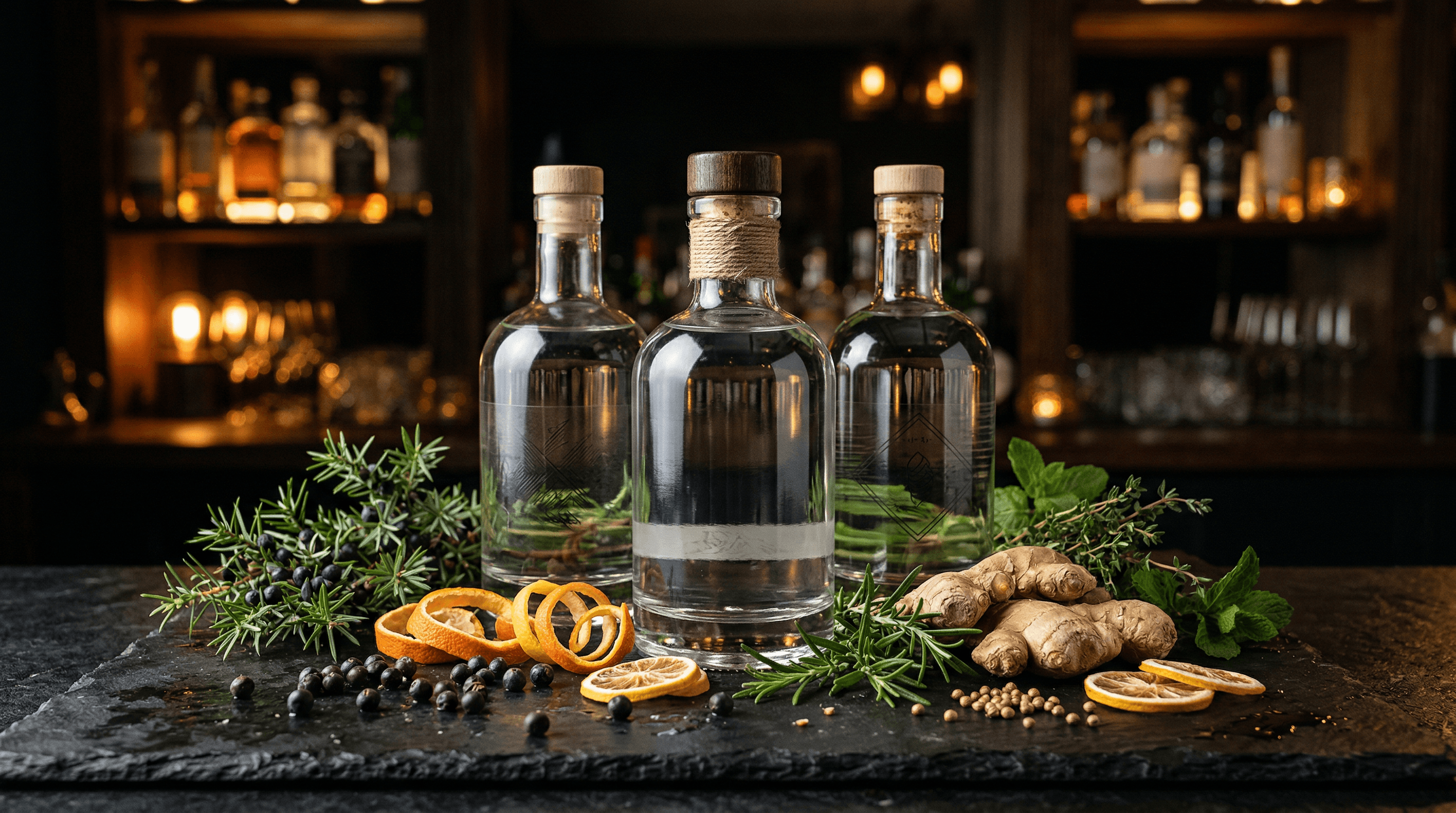
The non-alcoholic botanical spirits shelf has quietly become one of the most creative corners of the drinks world. While some brands chase perfect replicas of gin, whisky, and rum, the most interesting producers have gone in a completely different direction, and the results are worth paying attention to.
The burn problem (and how producers solve it)
- Ethanol elicits and potentiates nociceptor responses via the vanilloid receptor (TRPV1), Nature Neuroscience 2002
- Ginger pungent compounds and capsaicin share TRPV1 binding residues, PMC 2019
- McNamara et al., piperine activates the human TRPV1 vanilloid receptor, Br J Pharmacol 2005
- Bautista et al., pungent agents from Szechuan peppers excite sensory neurons by inhibiting two-pore potassium channels, Nature Neuroscience 2008
- Beck Flavors: replicating the burn in non-alcoholic spirits
- Peak Scientific: the chemistry behind ginger and gingerol
When you sip a spirit, the defining sensation isn't really the flavour. It's the warmth: that burn in your mouth and throat caused by ethanol hitting your heat and pain receptors. Flavour chemists call this a trigeminal sensation, not a taste, and replicating it without alcohol is the biggest challenge in the AF spirits world.
Producers have found some clever solutions. Capsaicin from chilli provides sharp, immediate heat. Gingerol from ginger and piperine from black pepper create a layered warmth at the back of the throat. All three activate the same heat-and-pain receptor (TRPV1) that ethanol does, which is why they produce such similar sensations. Sanshools from Sichuan pepper add a distinctive numb-tingling on top via a separate set of nerve channels.
Glycerine, fibres, and other texturising components add the viscosity and slick mouth-coating feel of a proper spirit. None of these are perfect substitutes on their own, but layered together they create something genuinely convincing, particularly in a mixed drink.
“None of these are perfect substitutes on their own, but layered together they create something genuinely convincing”
Where the dupes work: gin leads the way
Gin is the success story of AF spirits, and for a simple reason: its primary flavour, juniper, doesn't need alcohol to taste punchy. Juniper berries, citrus peel, and coriander can be extracted through steam distillation or maceration, and the results translate beautifully into an AF format. The best AF gin alternatives, like Tanqueray 0.0, Monday, and Caleno's G&T-style bottling, are close enough to the real thing that most drinkers wouldn't guess over ice with a decent tonic.
Aperitifs are another category that works well. Drinks built on gentian root, wormwood, and bitter botanicals have a natural intensity that compensates for the missing alcohol. Botivo, Wilfred's, and Ghia all deliver that bitter, complex sipping experience.
Rum and tequila are getting there. Caleño Dark and Spicy does a convincing job with molasses and warming spices, and the agave flavour in AF tequila alternatives is achievable, though the "bite" is harder to nail.
Whisky is the toughest category. The combination of oak, smoke, and complex heat is deeply intertwined with alcohol. Many AF whisky alternatives lean on caramel and vanilla, which can feel one-dimensional. Spiritless Kentucky 74 and Ritual are the best attempts, but they work better in cocktails than neat. For a more exhaustive tour of what's winning awards and retail listings right now, our best alcohol-free spirits UK guide covers the current roster.
Beyond dupes: the non-alcoholic botanical spirits revolution
The most exciting developments aren't coming from the mimicry side at all. Brands like Seedlip, Pentire, and Three Spirit have stopped trying to replicate existing spirits and instead created entirely new flavour profiles using herbs, roots, and botanicals.
Seedlip founder Ben Branson has been explicit that the brand wasn't built to mimic gin. He deliberately left juniper out to avoid the comparison, framing the project as a new non-alcoholic category from the start. That framing, rather than "AF gin", is what the category has grown into. Some producers have even started describing themselves in terroir terms, leaning on the specific plants grown in a single region: Pentire's Cornish coastal botanicals, Three Spirit's global herbal apothecary.
This matters because it sidesteps the "disappointment gap" entirely. When you order a "non-alcoholic whisky", you're primed for comparison. When you order a "botanical elixir" with damiana, lion's mane, and yerba mate, you judge it on its own terms.
The functional frontier: adaptogen drinks go mainstream
- Nobre et al., L-theanine and its effect on mental state, APJCN 2008
- Ginseng and memory: systematic review and meta-analysis, Phytotherapy Research 2024
- Ganoderma lucidum (reishi) RCTs, GRADE-assessed systematic review, Food Science & Nutrition 2025
- Three Spirit: The Nightcap
- Three Spirit: The Social Elixir
- IWSR: Key Statistics and Trends for the US No-Alcohol Market
The newest wave of botanical alcohol-free drinks goes beyond taste entirely. Functional beverages use adaptogens and nootropics with some evidence behind them. L-theanine from green tea has been shown in human EEG studies to increase alpha brain wave activity within an hour of ingestion, producing what researchers describe as "relaxation without causing drowsiness".
Panax ginseng has a recent peer-reviewed systematic review behind it for memory improvement. Reishi is traditionally classed as an adaptogen for stress, though the human clinical evidence is still catching up: a 2025 GRADE review of reishi RCTs (focused on metabolic and cardiovascular outcomes) found the quality of evidence very low across all outcomes, a useful proxy for how thin the broader human evidence base remains.
Three Spirit is the most interesting operator here. Their Nightcap leans on ashwagandha, valerian root, lemon balm, and hops for a calming, earthy evening drink. Their Social Elixir uses damiana leaf, lion's mane mushroom, and yerba mate for the middle of a night out. Neither is trying to taste like gin or vodka; they're functional alcohol-free drinks built on their own terms, and they work brilliantly with tonic, ginger beer, or in creative cocktails.
**+18% CAGR**
Forecast US no-alcohol spirits volume growth, 2024–2028 (IWSR). The US is the most-watched market for no-alcohol category growth.
This isn't wellness woo. Brands like TRIP, Three Spirit, and Kin Euphorics have built genuine followings among people who want the ritual of an evening drink and something more interesting than a soft drink, without the alcohol.
What to actually try
- Gin replacement: Tanqueray 0.0 with tonic. Hard to clock as alcohol-free
- Aperitif hour: Botivo or Ghia over ice. Bitter, complex, properly grown-up
- Something new: Three Spirit Social Elixir with ginger beer. You'll forget you were looking for a spirit replacement
- Evening wind-down: Three Spirit Nightcap. The ashwagandha and valerian actually do something
- In cocktails: most AF spirits work better in mixed drinks than neat. A Seedlip Garden with tonic and cucumber is a modern classic, and the full alcohol-free spirits range is where most of the category's most interesting launches land first
The non-alcoholic botanical spirits world is at its most interesting when it stops looking backwards at what alcohol used to do and starts building something new. The best AF spirit you'll drink this year probably won't remind you of any traditional spirit at all.