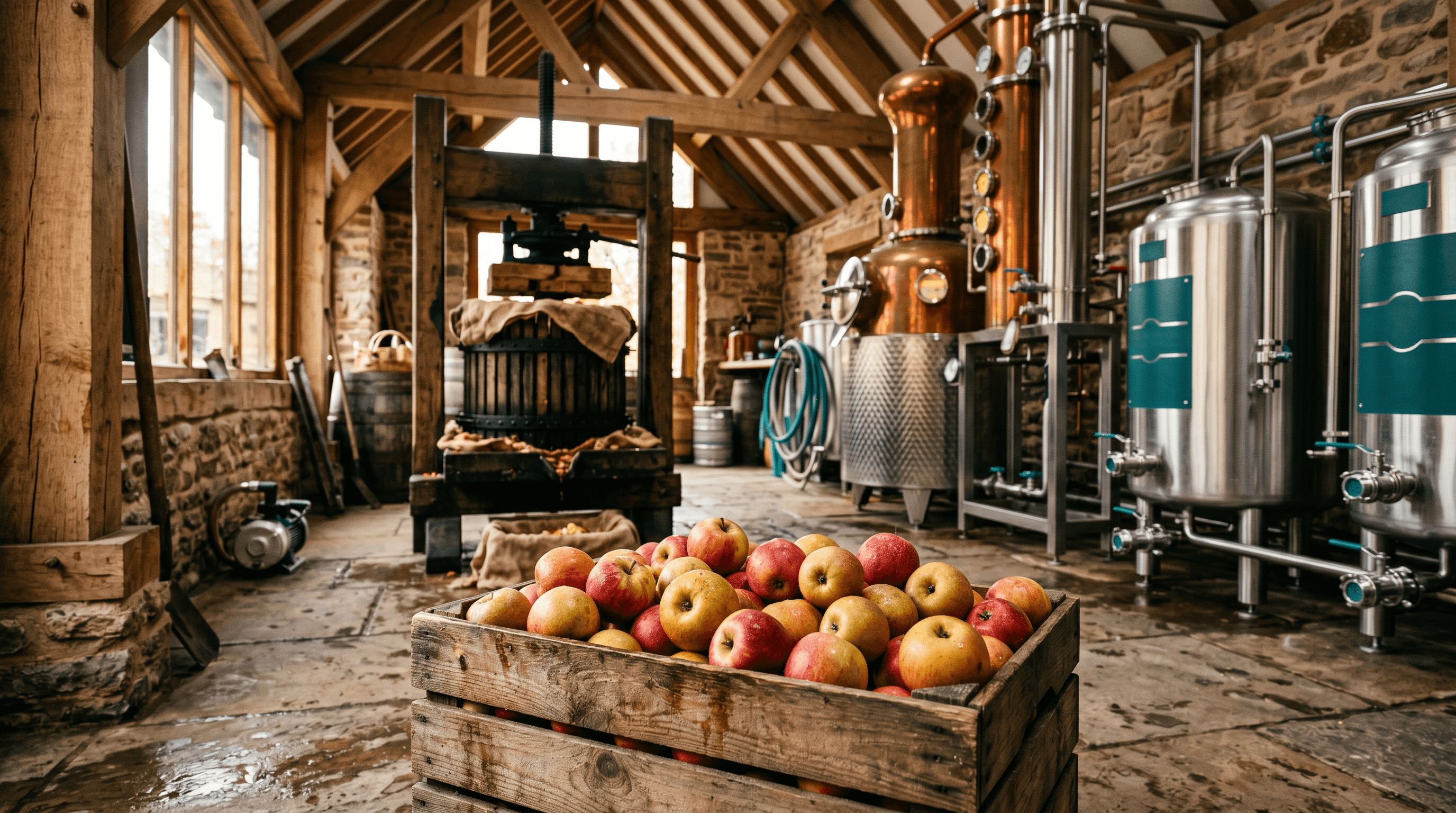
How is alcohol removed from cider? Broadly the same way it's removed from beer: ferment fully, then strip the alcohol out, with a few apple-specific twists. Cider's flavour profile is fruitier and more delicate than beer's, and its volatile apple esters are easier to lose during processing. So cider producers tend to favour the gentler end of the dealcoholisation toolkit, and they care a lot about aroma recovery.
Decent alcohol-free cider has grown into a real category in the last few years. Here's what actually happens between the orchard and the AF bottle.
How Is Alcohol Removed From Cider? The Short Version
Commercial AF cider production follows a four-step pattern.
1. Crush and press apples. Same as any cider. Apple varieties, blends and juice quality matter just as much for AF production as for full-strength. Bittersweet apples for tannin, sharps for acid, bittersharps for balance, sweets for body. The four-category taxonomy comes from Long Ashton Research Station's 1903 classification.
2. Ferment the juice. Conventional fermentation with yeast. The cider ferments down to whatever ABV the producer targets: typical commercial cider strengths run in the mid-single-digits, depending on apple type and desired style.
3. Remove the alcohol. This is where the dealcoholisation technology kicks in. Industry technical sources describe the most widely used approach as a combination of vacuum distillation and reverse osmosis: the same toolkit beer and wine producers use, tuned for apple fermentation.
4. Rebalance and package. Restore lost carbonation, adjust sweetness and acidity, and bottle or can.
The gap between fermented cider strength and the AF target (below 0.5%, usually below 0.05% for "alcohol-free" labelling in the UK) is smaller than wine's 12-15% to 0.5% drop but similar to beer's. That narrower gap makes the same dealcoholisation methods viable.
Why Apple Aromatics Are Fragile
The big difference between cider dealcoholisation and beer dealcoholisation isn't the equipment. It's what you're trying to preserve.
Beer's signature comes from hops: intensely aromatic, forgiving of processing, easy to supplement with fresh additions if some is lost. Hoppy AF beers can absorb a surprising amount of processing damage and still taste right.
Cider's signature comes from a more subtle palette of volatile esters. Compounds like hexyl acetate, which carries a green-apple aroma signature and is one of the basic components of cider apple flavour, are easily lost to heat or aggressive processing. They also can't be straightforwardly "added back" the way hop extract can. If you lose the apple character, you can't dose a bottle of apple essence to fix it without tasting confected.
That's why gentle, low-temperature methods matter so much for cider. A vacuum distillation system running at 30-35°C will keep far more of the apple character than a higher-temperature setup. A membrane process running at 8-10°C operates at lower temperatures still, though membranes have their own volatile-loss limitations to manage.
Aroma recovery, capturing the volatile esters before alcohol removal and returning them afterwards, is the gold standard. It's not universal in AF cider production, but it's what distinguishes premium AF cider from the budget end.
What Kopparberg Tells Us
Most cider producers don't publish the precise details of their dealcoholisation process. Kopparberg's FAQ confirms their alcohol-free range finishes below 0.05% ABV and is honest about trace alcohol always remaining: 'There will always be a trace of alcohol in products such as this, the same is the case for non alcoholic beers.'
That candour is welcome. As Kopparberg acknowledges, absolute removal at industrial scale isn't practical, so a tiny trace almost always remains. The UK's "alcohol-free" threshold of 0.05% reflects this reality and remains in force at the time of writing, though a government consultation has been promised on raising it to 0.5% to align with international standards.
Smaller producers often work with specialist dealcoholisation partners rather than running their own spinning cone column or reverse osmosis line, sending fermented cider out for the alcohol-removal step.
Our full alcohol-free cider primer covers the flavour side of why AF cider has been such a breakout category.
Vacuum Distillation for Cider
Vacuum distillation is the main workhorse for AF cider production. The principle is identical to wine or beer vacuum distillation: reduce the pressure so alcohol's boiling point drops well below the point where apple aromatics start to cook. Under deep vacuum, ethanol's boiling point can fall to as low as 30-35°C.
At that temperature:
- Ethanol evaporates readily
- Most volatile apple esters stay intact
- Heat damage to the fruit character is minimal
- The process is fast enough to work at commercial scale
Packed column configurations, where the cider passes through a column filled with packing material to increase surface area, improve efficiency. Some setups capture aroma compounds separately during the distillation and blend them back into the finished AF cider after alcohol removal.
The equipment is smaller than a winery's vacuum line would need to be (cider's lower starting ABV means less alcohol to remove per litre) but the principle is the same.
Reverse Osmosis for Cider
Reverse osmosis (RO) gets used for cider too, typically in combination with vacuum distillation rather than as a standalone method.
RO's advantage is temperature: operating at roughly 8-10°C, it's gentler still on apple aromatics than vacuum distillation. The process sends cider through a fine membrane that separates the liquid into a permeate (water and alcohol, which gets sent for separate distillation) and a retentate (concentrated flavour essence, which gets water added back to reconstitute volume).
RO's limitation is reduction depth per pass. Industry data puts a single pass at roughly 0.7-1.5% ABV reduction, so getting from cider strength to 0.5% requires multiple passes. That's why producers typically combine RO with vacuum distillation rather than relying on either alone: each method does what it does best, with RO preserving aromatics through the bulk of the removal and vacuum distillation handling deep reduction.
Combining methods is the industry standard for AF beverage production: PureTech Systems describes a combination of vacuum distillation and reverse osmosis as the most widely used technique for dealcoholisation today.
What Happens After Dealcoholisation
Strip the alcohol out of cider and you're left with a liquid that's thinner, sharper and less complex than the original. Producers rebalance the finished cider in several ways:
Sweetness. Alcohol provides a perceived sweetness on the palate. AF cider makers often add back a touch of apple juice concentrate or sugar to restore that. The best producers do so subtly. The worst produce something that tastes like sweetened apple juice.
Carbonation. Cider loses some CO2 during processing, and most AF ciders get re-carbonated to match the sparkle expected of the style. This is particularly important to traditional cider drinkers: a flat cider reads wrong regardless of alcohol content.
Acidity. Fermentation develops acids that give cider its bite. If those acids get damaged during processing, malic or citric acid may be added to rebalance.
Tannin structure. Bittersweet apple varieties bring tannin to the finished cider. Heavily processed AF cider can lose that tannic edge and taste like flat apple juice. Some producers supplement with tannin preparations to restore bite.
Natural flavourings. Apple-derived extracts or natural aromatics may be blended in to compensate for volatiles lost in processing. The ingredient list will reflect this.
How to Tell Good AF Cider From Bad
The same signals apply as for AF wine or beer. Look for these:
- Short ingredient list. Cider, apple juice concentrate, CO2. Clean label. Multiple sweeteners and colourings means masking, not preserving.
- Producer focus. Dedicated cider houses like Thatchers and Sheppy's, with established reputations in full-strength cider, tend to bring that craft into their AF ranges. Big multi-product brewers produce AF cider at varying quality.
Plus a couple of palate signals:
- Apple variety honesty. If the producer names the apple blend, they're proud of what went in. Generic "apple" with heavy sweetening is usually budget territory.
- Dryness vs sweetness. Convincing AF cider can be dry. Heavily sweetened AF cider usually means the base wasn't good enough to stand on its own.
The Bottom Line
How is alcohol removed from cider? Usually by combining vacuum distillation with reverse osmosis, tuned to preserve the delicate apple esters that give cider its character. If you lose the apple character in cider, you can't dose a bottle of apple essence to fix it without tasting confected. The methods are the same ones used for beer and wine, the same toolkit and the same principles, adapted for apple fermentation's fruitier, more volatile profile.
“If you lose the apple character in cider, you can't dose a bottle of apple essence to fix it without tasting confected”
The AF cider category has moved fast in the last five years. Honest producers, gentle processing, and careful post-processing have lifted the category out of the "sweetened apple juice" reputation it used to deserve. Modern AF cider can genuinely taste like cider. Not every bottle does, but the good ones are unmistakably real.