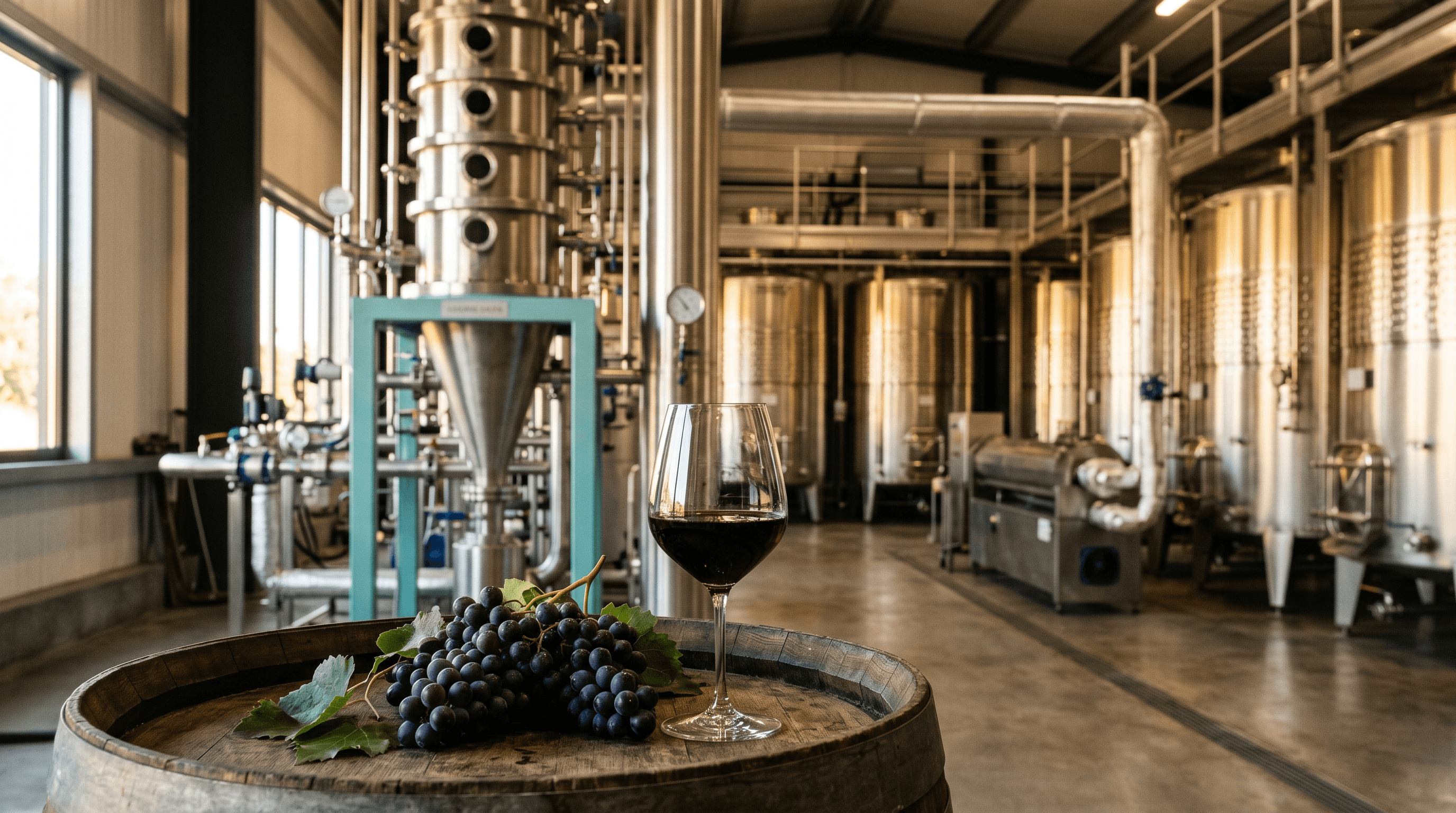
How is alcohol removed from wine without destroying everything that makes wine taste like wine? Of all the dealcoholisation jobs in the drinks world, wine is the hardest. Starting ABV typically runs from around 5% for lighter styles like Moscato d'Asti up to 13.5-15% for full-bodied, warm-climate reds, with most table wines around 11-13%. The non-alcoholic target is below 0.5%. That's a dramatic drop, more than a full order of magnitude, and every step threatens the delicate tannins, aromatic esters and acid balance that define good wine.
Producers have spent decades solving this problem. The result is a toolkit of gentle, low-temperature methods that can strip alcohol while keeping flavour intact, at least for wines chosen specifically with dealcoholisation in mind.
How Is Alcohol Removed From Wine? Why the Job Is So Hard
Wine carries more alcohol than beer or cider to start with. Most table wines run 11-13%, warm-climate reds can push 15%, and lighter styles like Moscato d'Asti dip below 6%. Either way, the journey to below 0.5% is a bigger lift than beer's 5% to 0.5%.
Wine is also more delicate. Beer can be hopped forward to mask processing artefacts. Wine's aromatic signature depends on hundreds of subtle volatile compounds, the floral and fruit-smelling molecules that develop during fermentation and ageing.
Most of those compounds are volatile. Apply too much heat, too much pressure, or too much processing time and they simply leave with the alcohol.
And wine's tannin structure, acid balance and mouthfeel depend on the alcohol being there. Strip it out and the tannins can taste harsher, the acid sharper, the body thinner. Producers have to compensate, and the best ones do so without resorting to heavy sweetening or blatant additive dosing.
The upshot is that even with the gentlest technology, some character loss is inevitable. The question is how much, and how well-masked. Our AF wine problem explainer digs into why even expensive AF wines often disappoint.
The Spinning Cone Column: Industry Standard for Premium AF Wine
The spinning cone column (SCC) has become the dominant technology for serious AF wine. Manufactured by Flavourtech, an Australian engineering company, the SCC is a vertical column where alternating fixed cones (attached to the walls) and spinning cones (attached to a central shaft) create thin films of liquid. Steam rises through the films, stripping volatile compounds at low temperatures.
The numbers that matter, all per Flavourtech's own technical materials: the column runs at around 30°C for aroma capture and roughly 40°C for alcohol removal, with a product residence time of just 25 seconds. That combination of low heat and short contact is why SCC is widely considered the gentlest method available.
The process works in two passes, plus a final reunification:
- Aroma capture. The wine runs through the SCC first at a lower temperature. Volatile aromatics evaporate into a small concentrated fraction that contains most of what makes the wine smell like wine. This fraction gets held aside.
- Alcohol removal. The dealcoholised wine (now flat and aromatically weakened) runs through a second pass at higher temperature. Alcohol evaporates off. What's left is a low-alcohol base.
- Reunification. The captured aromas go back into the dealcoholised base. The result, ideally, is a wine that smells and tastes close to the original, minus the alcohol.
Flavourtech describes around 600 winemakers on the US west coast alone as SCC users. If you buy a premium AF wine from a serious producer, there's a strong chance it went through an SCC somewhere in its production.
The catch is cost. SCC equipment is expensive, and most wineries can't justify installing their own line. Many use specialist contract dealcoholisation services. A winery sends its full-strength wine to a facility with SCC equipment, then receives the AF version back for bottling under its own label.
Vacuum Distillation: The Original Method
The oldest commercial dealcoholisation method is still one of the most widely used. Carl Jung, a German winemaker, developed vacuum distillation for wine in 1907. The principle is the same as any distillation: alcohol boils at a lower temperature than water, so heat the liquid and the alcohol evaporates first. The refinement is in the pressure. Under reduced pressure, alcohol's boiling point drops dramatically.
Modern vacuum distillation equipment for wine operates at around 30-50°C. At that temperature, alcohol evaporates readily while most aromatic compounds survive. It remains a workhorse of mid-market AF wine, especially in Germany.
Germany is the quality powerhouse for AF wine in large part because German producers invested in vacuum distillation decades ago. Carl Jung's original company still exists, primarily producing AF wine as a contract dealcoholiser for other brands, alongside a smaller range under its own Jung label. SevenFifty Daily reports around 100 German wineries now offer AF lines, and Geisenheim University researchers have worked on dealcoholisation for some 40 years; that head start is widely credited for the category strength of German AF wines today.
Some setups capture aroma compounds in a separate condenser and blend them back after alcohol removal, similar to the SCC's two-stage approach.
Reverse Osmosis and Membrane Methods
Not all methods use heat. Membrane processes (reverse osmosis, nanofiltration, osmotic distillation, pervaporation) use pressure or concentration gradients to separate alcohol from the rest of the wine at ambient or near-ambient temperature. Dialysis has been trialled too, but remains at the research stage rather than established commercial use.
Peer-reviewed research identifies osmotic distillation, reverse osmosis, pervaporation, vacuum distillation and the spinning cone column as the main dealcoholisation methods used commercially for wine. They can partially or completely reduce alcohol content, and different wines may suit different combinations.
Reverse osmosis (RO) uses fine membranes that let water and alcohol through while blocking larger flavour compounds. The permeate (water + alcohol) then goes through a separate distillation to remove the alcohol, and the water returns to the wine concentrate left behind (the retentate). RO struggles with dramatic reductions (you can't go from 13% to 0.5% in one pass), so for AF wine it's usually combined with distillation.
Osmotic distillation uses a hydrophobic membrane and a water extracting stream. Ethanol has high vapour pressure, so it transitions from the wine side to the water side through the membrane pores. No heat, no pressure: as gentle as any method gets. Best for partial reduction (dropping a few percentage points) rather than full dealcoholisation.
Pervaporation runs the wine past a tight membrane with vacuum drawing alcohol through to the other side. Flavour compounds stay behind. Processing rates are slow, so it tends to be combined with other methods rather than used alone.
In practice, most commercial AF wine combines methods. A winery uses reverse osmosis for preliminary volume reduction, then finishes with vacuum distillation or SCC for the last couple of percent. The full alcohol removal methods guide covers each of these techniques in more depth.
What Happens to the Wine After
Dealcoholisation isn't the finish line. Stripping alcohol out leaves a liquid that's typically thinner, sharper and more acidic than the original. Producers have to rebalance it.
Common post-processing steps:
For body and sweetness:
- Grape juice or must addition. The cheapest way to restore body and sweetness. Done heavily, this is why budget AF wines taste like grape juice.
- Glycerol. Restores some of the body and perceived viscosity that alcohol provided. Used cautiously at premium end.
- Sugar and sweeteners. Compensates for the sweetness that alcohol contributed. Labels vary wildly, so check if sugar content matters to you.
For structural finish:
- Tannin and acid adjustments. Fine-tuning the balance that removal disrupted.
- Carbon dioxide. For sparkling versions, and surprisingly many non-sparkling versions, to add a fresh edge.
- Natural flavourings. Grape-derived extracts, oak flavourings, other permitted additives that replace volatiles lost during processing.
The best producers avoid most of these. The thinking: choose a base wine that will survive dealcoholisation, use the gentlest method available, preserve the original aromatics, and let the finished wine speak for itself. The worst producers lean heavily on sweeteners and juice to mask the damage of aggressive processing.
How to Tell Good Dealcoholised Wine From Bad
You can't always tell from the label. But there are signals:
Producer reputation. Long-established AF-focused producers (Carl Jung, Pierre Chavin, Leitz, Torres) have had decades to refine their process. Newer entrants vary wildly.
Base grape variety. Wines made from aromatic, terpene-rich white varieties such as Riesling, Muscat and Gewürztraminer may hold their character through dealcoholisation more favourably, because their fruity, floral aromatics are so pronounced to begin with. It's one reason a fair share of the most convincing AF wines are aromatic whites.
Ingredient list length. A short list (wine, grape juice, CO2) is a promising sign. A long list (multiple sweeteners, flavourings, preservatives) points to heavy post-processing compensation.
Sugar content per serving. As a rough editorial guide, under 2g per 100ml suggests a lean style; over 5g often means sugar is doing heavy lifting the base wine couldn't. There's no regulatory threshold here; the bands are our own benchmarks based on tasting across the category.
Price. AF wine done well is expensive. The base wine costs nearly as much as the full-strength version, and the dealcoholisation adds cost on top. Cheap supermarket bottles rarely use premium processes.
The Bottom Line
The best producers run their wines through gentle, low-temperature processes with careful aroma recovery. With wine, the dealcoholisation process is a quality-limiting step in its own right; even the gentlest technology has costs. The worst producers strip the alcohol aggressively and paper over the damage with grape juice and sugar.
“With wine, the dealcoholisation process is a quality-limiting step in its own right; even the gentlest technology has costs”
Given the difficulty, the best modern AF wines are genuinely impressive: clearly wine-like, balanced, drinkable. But the category rewards research before buying. Not every bottle labelled "alcohol-free wine" is worth the money.