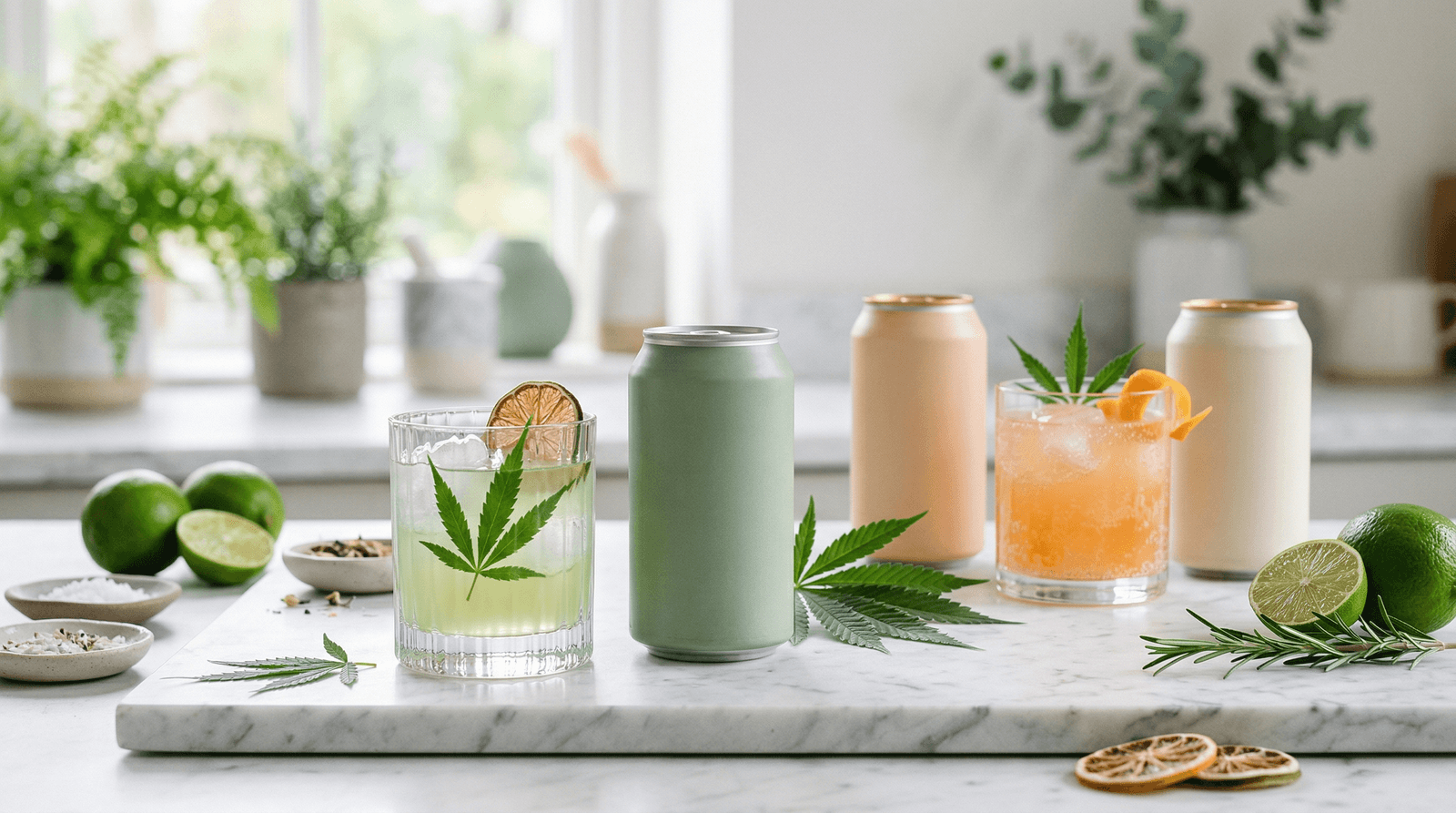
CBD sparkling water on the supermarket shelf, wedged between the kombucha and the alcohol-free gin. Five years ago that sounded illegal. Today it looks perfectly ordinary in the UK, contested in the US, paused in the EU, locked behind a cannabis counter in Canada and absent from Australian shelves. Trip, Goodrays, Intune, OTO. The cans are beautiful. The claims are bold. Calm. Focus. Sleep.
But are CBD drinks legal where you live? What's actually in the can? Do CBD drinks work? And why does flavoured sparkling water cost more than a pint of milk or a takeaway coffee?
We looked at CBD drink laws across five countries, the science, and the economics.
Are CBD drinks legal? It depends where you are
The short answer: it depends entirely on where you live. CBD drinks sit in a different legal category in almost every major market.
| UK | US | EU | Canada | Australia | |
|---|---|---|---|---|---|
| Sold as food/drink? | Yes, via Novel Food | Grey, state-led | Stalled | No, cannabis only | No, pharmacy only |
| Regulator | FSA | FDA | EFSA | Health Canada | TGA |
| Daily CBD guide | 10mg advisory | None | ~2mg provisional | None | 150mg pharmacy |
| Approval state | Autumn 2026 target | No food approval | Paused 2022 | No pathway | S3 unused |
CBD drinks UK: legal with caveats
- Register of CBD products linked to novel food applications, FSA
- Analytical limits for controlled cannabinoids in CBD products, gov.uk
- FSA consumer advice for CBD, gov.uk
- UK FSA advises no more than 10mg CBD per day, Food Safety Magazine
- Leading CBD brands reformulate drinks in line with FSA guidance (April 2026), The Grocer
- CBD novel food applications board paper, FSA
- Is CBD heading towards a frozen UK market?, Nutraingredients (April 2026)
CBD was classified as a Novel Food in 2019. Any product containing it needs pre-market authorisation from the Food Standards Agency. The FSA maintains a public list of CBD products linked to valid applications. If a product isn't on that list, it shouldn't be on the shelf.
The enforceable rule is simple: no product may exceed 1mg of controlled cannabinoids (including THC) per finished container. That is a hard Home Office line. The FSA also advises a maximum daily intake of 10mg CBD for healthy adults, and recommends against CBD altogether for under-18s, pregnant or breastfeeding women, anyone trying to conceive, and people on medication.
Here's the catch: that 10mg guidance is advisory only, not enforced. But it has still moved the market. Trip cut its cans from 15mg to 10mg in 2025, and Goodrays followed in April 2026, dropping from 30mg to 10mg in line with the FSA's advice. Intune was already at 10mg. OTO is currently the outlier among the headline brands, still sitting at 25mg per can. None of these brands are breaking the law, but the practical floor of "what UK CBD drinks contain" has reset close to the FSA's 10mg/day figure within the last year.
The first formal Novel Food authorisations were targeted for autumn 2026, after the FSA opened the file for public consultation. High-purity CBD applications have received positive safety assessments and sit in risk management. But the timeline depends on Food Standards Scotland's parallel process concluding too, and as of May 2026 nothing has been formally authorised yet. Until approvals land, the CBD drinks UK market operates in a grey zone: technically regulated, practically tolerated.
CBD drink laws in the US: federally legal, practically chaotic
The US situation is genuinely confusing. Hemp-derived CBD became federally legal under the 2018 Farm Bill, which defined hemp as cannabis containing no more than 0.3% delta-9 THC by dry weight.
But the FDA has never approved CBD as a food or drink ingredient. The only FDA-approved CBD product is Epidiolex, a prescription epilepsy medication. CBD drinks therefore exist in a regulatory gap. Some states allow them freely, others restrict or ban them.
A major change is coming. Congress passed Section 781 of the Continuing Resolution in November 2025. From 12 November 2026, hemp-derived consumer products must contain no more than 0.4mg of total THC (including THCA) per finished container. That is tight enough that most intoxicating hemp beverages, and many existing CBD products with measurable THC traces, will effectively be off the shelves.
Are CBD drinks legal in the EU? Technically, but stalled
The EU also classifies CBD as a Novel Food, but progress has been even slower than the UK. More than 200 applications have been submitted to the European Food Safety Authority. Only 17 are currently under assessment. None have been approved. EFSA paused all CBD assessments in 2022, citing insufficient safety data on liver, gut, hormonal, psychological and reproductive effects.
In February 2026, EFSA published a provisional safe intake level of 0.0275 mg/kg of body weight per day, roughly 2mg CBD per day for a 70kg (about 154 lb) adult. That's one-fifth of the UK's already conservative 10mg guidance and would make most current CBD drinks non-compliant. EFSA's opinion applies only to supplements at 98% or higher CBD purity, and explicitly excludes under-25s, pregnant or lactating women, and anyone on medication.
CBD drinks are available across Europe, but in a legal limbo that makes the UK look well-regulated by comparison.
CBD drinks in Canada: cannabis shop only
CBD is legal but regulated under the Cannabis Act, which means it can only be sold through licensed cannabis retailers. You won't find Trip in a Canadian supermarket. Health Canada had signalled a pathway for non-prescription CBD health products in its 2024 to 2026 Forward Regulatory Plan, but the proposal was formally dropped from the 2025 to 2027 plan in early 2026. CBD drinks exist, but they're sold alongside recreational cannabis products, not in the soft drinks aisle.
CBD drinks in Australia: pharmacy-only, in theory
Australia takes the most restrictive approach among English-speaking countries. CBD was historically prescription-only. Since February 2021, the Therapeutic Goods Administration has operated a Schedule 3 pathway, allowing pharmacists to sell low-dose CBD (up to 150mg per day, 98% or higher purity, adults only) without a prescription.
In practice the pathway is largely theoretical. As of 2026, no Schedule 3 CBD products have actually cleared approval to appear on the Australian Register of Therapeutic Goods. CBD drinks as casual supermarket purchases simply don't exist there.
Do CBD drinks work? What the science actually says
- Epidiolex (cannabidiol) prescribing information, DailyMed
- Han et al. (2024), CBD for anxiety disorders meta-analysis, Psychiatry Research
- Shannon et al. (2019), CBD in anxiety and sleep case series, Permanente Journal
- Cannabidiol treatment for anxiety disorders, RCT review (de Faria Coelho et al., 2024), Life
- Perucca and Bialer (2020), Critical aspects of CBD oral bioavailability, CNS Drugs
- CBD Beverages Market 2035 forecast, Fact.MR
This is where it gets honest.
CBD has genuine pharmacological properties. It's not snake oil. Epidiolex, the prescription-strength version, is approved by the US FDA and UK MHRA for severe epilepsy. Maintenance dosing runs from 10mg/kg/day up to 20mg/kg/day for Lennox-Gastaut and Dravet syndromes, and up to 25mg/kg/day for tuberous sclerosis. For a 70kg (154 lb) adult, that's 700 to 1,750mg per day.
A can of Trip contains 10mg.
What the clinical trials actually show
Studies that have shown measurable effects on anxiety or sleep typically use single oral doses of 300 to 600mg. A 2024 meta-analysis in Psychiatry Research (Han et al.) pooled eight trials across 316 participants and found a large, statistically significant anxiety reduction (Hedges' g of about minus 0.92). A real effect, but every trial used a dose at least ten times what a CBD drink delivers.
One widely cited case series of 72 adults (Shannon et al., 2019) found anxiety scores fell in 79% of participants and sleep improved in 67% within the first month. Promising. But nearly all those patients were taking 25mg daily in capsule form (one was titrated up to 175mg), not sipping a peach and ginger sparkling water. The paper also notes sleep scores fluctuated over longer follow-up.
CBD drink benefits are not linear with dose
More CBD isn't simply better. A 2024 systematic review of randomised controlled trials (de Faria Coelho et al.) found CBD produces an inverted U-shaped dose-response curve: 300mg single doses reduced public-speaking anxiety in three of four studies, but 600mg single doses failed to reduce anxiety, and in some contexts actually increased it. The review concludes that responses vary with the nature of the stressor: different stressors appear to engage distinct anxiety mechanisms, so CBD's effect depends on condition, severity and timing.
Which is a polite way of saying: "drink one can for calm" isn't something the evidence supports.
The bioavailability problem
There's also what happens after you swallow. Oral CBD is poorly absorbed. The best-known pharmacokinetic review (Perucca and Bialer, 2020) gives the absolute bioavailability under fasted conditions as roughly 6%, rising about fourfold when CBD is taken with a high-fat meal.
So the CBD in your can might deliver 1 to 2mg to your bloodstream if you're drinking it as a standalone refreshment. Even less if you're hoping the CBD works faster than alcohol would, which is how most people drink these in the evening.
The honest summary: CBD probably does something useful at high doses under the right conditions. Whether CBD drinks work at the doses in a sparkling can, sipped without food, is at best unproven.
**$4.6 billion (~£3.5 billion)**
Projected global CBD beverages market by 2035 (Fact.MR)
10mg
UK FSA recommended daily CBD intake (advisory)
~2mg
EU EFSA provisional daily limit (Feb 2026)
10 to 25mg
Typical CBD content per drink can after the 2025-2026 UK reformulation wave
300 to 600mg
Dose range used in trials that showed measurable anxiety effects
~6% (fasted)
Oral bioavailability of CBD, rising about 4x with a fatty meal
“"A can of CBD drink now contains 10 to 25mg of CBD. Trials that worked used 300mg or more."”
Why do CBD drinks cost so much?
Fair question. It's sparkling water with some flavouring and a few milligrams of hemp extract. So where does the money go?
Extraction. Getting CBD from hemp isn't like squeezing an orange. CO2 extraction, the gold-standard method, requires specialist equipment operating at high pressure and precise temperatures. It produces clean, consistent CBD isolate, but the kit is expensive and the process is slow.
Compliance. The UK's Novel Food process doesn't actually charge an application fee. But every dossier needs toxicology studies, stability testing, manufacturing analysis and third-party lab verification. A serious safety package is a substantial investment, and every batch then needs certificates of analysis for CBD and THC levels.
Testing. Each production run must be independently tested, and the UK Government Chemist has published specific guidance on CBD testing in novel foods.
Scale. CBD drinks are a niche within a niche. Smaller production runs mean higher per-unit costs for ingredients, canning, and distribution.
Branding. Let's be honest. CBD drinks are marketed as wellness products, not soft drinks. The packaging is beautiful, the positioning is premium, and the pricing reflects that.
For context, a standard bottle of CBD oil delivers CBD at a fraction of the cost per milligram compared to a CBD drink. You're paying a significant premium for the convenience, the fizzy water, and the ritual. Which is fine, just know what you're paying for.
So, are CBD drinks worth trying?
- Trip becomes fastest-growing UK soft drink, The Grocer
- Trip Mindful Blend bestsellers across major retailers, The Grocer
- Goodrays closes £5m fundraise (51% drinks sales growth to £5.4m, NIQ 52 we 14 June 2025), The Grocer
- Goodrays as Tesco's sole CBD drinks brand, Food and Drink Technology (March 2024)
- Intune CBD sodas range, intunedrinks.com
- OTO Wellbeing drinks collection, otowellbeing.com
Here's what people miss: these are genuinely nice drinks, CBD or not.
Trip's elderflower mint is crisp and refreshing. Goodrays make a peach and passion fruit that's properly tasty. Intune's pomegranate and ginger has real bite. They're well-made, low-calorie beverages that happen to contain hemp extract. If you're reaching for one instead of a glass of wine on a Tuesday evening, that's a good swap regardless of whether the CBD does anything, and it's the same logic behind the moderation menu or going alcohol-free altogether.
The ritual of opening something that feels a bit special has value. The placebo effect is real, measurable, and nothing to be snobbish about. It just shouldn't cost hundreds of pounds (or hundreds of dollars) a month to feel like you're making a good choice.
But manage your expectations. If you're buying CBD drinks specifically for anxiety relief or better sleep, the evidence says the doses are almost certainly too low to deliver clinical effects. You'd need to drink many cans to match the lowest dose shown to help with anxiety in trials. Please don't do that.
What the brands look like today
Trip is the UK's most visible CBD drinks brand, claiming around 88% of the UK CBD drinks market in a 2023 Trip-sourced figure (the company also notes that NielsenIQ-tracked sales represent less than 20% of its total revenue). With Goodrays' growth and a wave of reformulation across the category, that share is likely lower now. Trip's CBD seltzers are stocked across several major UK grocers and health retailers; Trip's Tesco shelves are its non-CBD Mindful Blend range, whose individual products are now Trip's bestsellers in Sainsbury's, Waitrose and Tesco according to The Grocer.
Goodrays posted CBD drinks sales growth of about 51% to £5.4m in the year to June 2025, per NielsenIQ data reported in trade press around its £5m fundraise. It is Tesco's sole CBD brand in the chain's functional-drinks bay, per the March 2024 launch announcement.
Intune offers interesting flavour combinations (pomegranate and ginger, elderflower and hops, grapefruit and mint) at 10mg per can, currently via specialist retailers rather than full supermarket shelves.
OTO contains 25mg CBD per seltzer can and sits in specialist online retailers and direct-to-consumer channels rather than mass-market supermarkets.
Buy one because you fancy trying something different. Don't buy a case expecting it to fix your sleep. If the CBD does something for you, brilliant. If it doesn't, you've still got a nice drink, and the same logic applies whether you're picking up a CBD can, an alcohol-free IPA with proper flavour, or a regular drink-free day. Somewhere in that gap is where CBD drinks actually live: pleasant, slightly overpriced, and more honest than most wellness products if you read the small print.