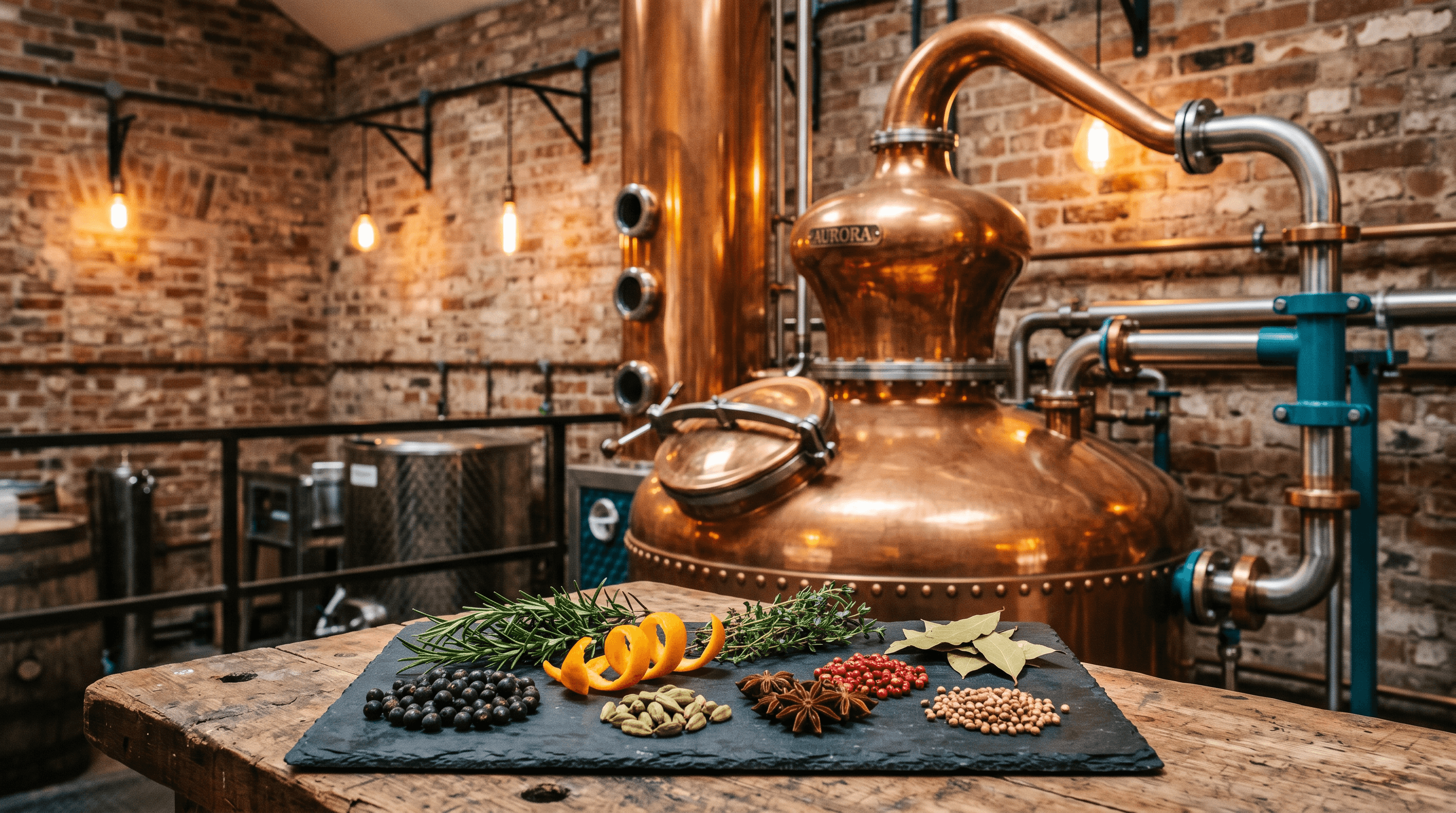
How are alcohol-free spirits made? Not by dealcoholising gin or whisky. That is the single most important fact about the AF spirits category, and the one most often misunderstood. Unlike alcohol-free beer, wine and cider, where producers ferment the drink normally and then strip the alcohol out, alcohol-free spirits are built from scratch. Every major AF spirit brand starts with a blank slate and engineers a finished product that tastes like a real spirit without ever containing one.
The reason is chemistry, not choice. Alcohol is so central to what a spirit is (it provides the burn, the warmth, the body, the way flavour compounds dissolve and release on the palate) that removing it from a finished whisky or gin leaves you with flavoured water. Try it with any high-ABV spirit and the reason becomes obvious.
How Are Alcohol-Free Spirits Made? Why You Cannot Dealcoholise a Spirit
Take a bottle of gin and run it through a vacuum distillation column to strip the alcohol. What comes out is a faintly juniper-scented water. It has none of the gin's body, none of its mouthfeel, almost none of its aromatic intensity. Juniper oil is volatile and comes off with the ethanol. The complex harmony of botanicals that a gin distiller spent years perfecting is gone or hopelessly diluted.
Now try whisky. Dealcoholising a Scotch leaves you with barrel-coloured water carrying only the most stubbornly water-soluble flavour compounds. The smoke, the caramel, the oak: all compounds that rely on alcohol as a solvent to reach your palate. Without ethanol carrying them, they do not taste like much.
This is why no major AF spirit brand dealcoholises an existing spirit. Lyre's puts it plainly on its FAQ: "Lyre's products are purposefully crafted as non-alcoholic from the outset." The team analyses the flavour profiles of classic spirits and recreates them using botanicals, extracts and natural flavours. The finished product is not a dealcoholised gin; it is a non-alcoholic beverage engineered to resemble gin.
The Seedlip Method: Botanical Distillation
- Seedlip Our Story (John French 1651 inspiration), seedlipdrinks.com
- Seedlip launched 2015 as the world's first distilled non-alcoholic spirit, Diageo (2019)
- How Seedlip is made (six-week maceration and copper pot distillation), Cook & Nelson
- Seedlip Garden 108 botanicals, seedlipdrinks.com
- Seedlip Spice 94 botanicals, seedlipdrinks.com
- Seedlip Grove 42 botanicals, seedlipdrinks.com
Seedlip launched in 2015. Diageo, which acquired a majority stake in 2019, describes it as the world's first distilled non-alcoholic spirit brand. The production method is rooted in 17th-century medicinal distillation but adapted for the modern non-alcoholic category. Founder Ben Branson credits John French's 1651 The Art of Distillation as inspiration: French documented non-alcoholic herbal recipes that Branson later experimented with on a small copper still at home. The Seedlip process takes around six weeks per batch and works like this:
1. Individual botanical maceration. Each botanical, hay for Garden 108, allspice for Spice 94, citrus for Grove 42, gets macerated separately in water and a small amount of neutral grain spirit. Each plant soaks for its own optimal time.
2. Copper pot distillation. Each macerated botanical is distilled individually in copper pot stills, producing a concentrated essence of that single botanical.
3. Alcohol removal and blending. The alcohol introduced at the maceration stage is removed using a proprietary method before blending. The individual botanical essences are then blended in precise ratios to create the final product. The blend is what gives each Seedlip variant its signature character.
The neutral grain spirit is a production solvent; it never ends up in the bottle. Like other commercial AF spirits, the finished product sits below the 0.5% ABV threshold that defines the category.
What Seedlip gets out of this approach is authenticity. Each botanical's character develops the same way it would in a traditional gin or amaro, just with the alcohol stripped back out at the end. Garden 108 leans on hay, hops, rosemary and thyme; Spice 94 builds around allspice and green cardamom; Grove 42 draws on bitter and blood oranges, lemongrass, ginger and Japanese sansho (a citrusy, mildly numbing peppercorn).
The Lyre's Method: Natural Flavour Engineering
Lyre's takes a different route: pure formulation. Rather than distilling botanicals, Lyre's chemists analyse the flavour profile of a classic spirit (London Dry gin, white rum, bourbon, amaretto) and reconstruct that profile using a selection of natural flavours, extracts and botanicals.
The advantage is range. Formulation lets a producer design a product to match a target flavour profile precisely, and lets the catalogue extend into categories that would be costly to reproduce via traditional distillation. Lyre's lineup spans gin, rum, American malt, Italian apéritif and amaretto alternatives built this way.
The trade-off is honesty about what's in the bottle. Formulation-based AF spirits have longer ingredient lists than distilled ones. That is not inherently bad. Lyre's products are made from food-safe natural flavours and extracts, but it is a different production philosophy from Seedlip's single-botanical-per-still approach.
The two approaches solve different problems. Seedlip's distillates make sense if you want a non-alcoholic drink that tastes like itself; you don't drink Garden 108 expecting gin. Lyre's makes more sense if you want a swap that drops cleanly into a Negroni, an Espresso Martini or an Old Fashioned, where the formulation is built to match the cocktail's expected flavour shape.
The Everleaf Method: Multiple Extraction Techniques
Everleaf takes a third route: matching the extraction method to each botanical individually.
Vetiver, an aromatic grass root, gets steam-distilled. Vanilla gets macerated in alcohol (the alcohol later gets processed out). Acacia gum gets ground into a fine powder to extract its texture-building properties. Other botanicals use different techniques depending on what the plant gives up most readily.
The extracts then get blended onto what Everleaf calls its "unique textured base liquid", a formulation specifically engineered to deliver the viscosity and mouthfeel that alcohol normally provides. Getting the body right is arguably the harder half of the AF spirits engineering problem. Everleaf's textured base is its proprietary answer to it.
The finished Everleaf products sit at less than 0.5% ABV. The aperitif-style formulations are designed for stirred cocktails and spritzes, where body matters more than raw flavour punch.
The Ritual Method: Food Science Formulation
Ritual Zero Proof's approach is the most openly food-science-led of the major AF spirit brands. The whiskey alternative is formulated from filtered water, cane sugar, natural flavours, xanthan gum, citric acid, caramel colour, and the preservatives sodium benzoate and potassium sorbate. A clean list of food-grade ingredients engineered to match the flavours, aromas and mouthfeel of traditional whiskey.
The xanthan gum is the interesting part. It is a thickener used widely in food production, and it does the same job in Ritual's whiskey alternative as it does in a good sauce: providing the body and viscous feel that alcohol would normally contribute. Other AF spirit producers use similar technical ingredients. Some use glycerol, some use gum arabic, some use specialised emulsifiers.
Purist drinkers sometimes dismiss the food-science approach as "not real". That misses the point. All AF spirits are engineered products by necessity; none of them are literally dealcoholised versions of real spirits. Some producers dress their engineering in the language of botanicals and traditional distillation. Others are more openly technical about it. The finished product is what matters on the palate.
The Mouthfeel Problem
Every AF spirit producer runs into the same wall. Alcohol does not just provide flavour carrier. It provides body, warmth, and a slight viscosity that gives a spirit its characteristic "feel" in the mouth. Strip that out and the finished product can taste thin, watery, and unsatisfying even if the flavour profile is perfect.
The engineering answers vary by producer:
- Gum arabic and xanthan gum. Food-grade thickeners that add viscosity
- Glycerol. Adds perceived body and a slight sweetness without heavy flavour impact
- Gum acacia extracts. Adds mouth-coating texture (Everleaf's acacia-grinding approach)
- Sugar and natural sweeteners. Compensate for the sweetness alcohol contributes
- Higher flavour concentration. Dialling up the aromatics to compensate for reduced flavour carrier
Each approach has trade-offs. Thickeners can feel artificial at higher doses. Sugar can make drinks cloying. Flavour concentration without body backup can taste harsh. The craft of AF spirit production is balancing these compensations so that no single one dominates.
How AF Spirits Taste in Cocktails
The real test of an AF spirit is not neat sipping; it is how it holds together once mixed. Cocktails are a hostile environment for thin or sweet AF spirits: vermouth flattens a flabby gin alternative, lime juice exposes a rum alternative that has nothing to push back, and bitters land harshly on a whiskey alternative without enough body to carry them.
AF spirit brands that take cocktails seriously design backwards from this problem. Lyre's calibrates for category-specific cocktail use; Seedlip skews toward stirred-and-tonic style serves where its botanical character can sit forward. The shared instinct is to add weight, sweetness control and a little bitterness so the drink reads as a cocktail rather than a flavoured soft drink.
A well-built AF cocktail can stand alongside its alcoholic counterpart on flavour, even if it cannot match the warming effect. UK readers can browse the alcohol-free spirits brands in the UK guide for current options.
The poorly-built AF cocktails taste like fruit juice with an aftertaste. The gap between best and worst is large, larger than in AF beer or wine, because the category is newer and the formulation challenges are bigger.
The Legal ABV Position
- No and low-alcohol labelling consultation 2023 (closed), gov.uk
- Will the UK finally change its definition of alcohol-free?, Beverage Daily (July 2025)
- NA wines and spirits below 0.5% ABV regulated by FDA not TTB, Wine Law on Reserve
- EU alcohol labelling rules (Reg 1169/2011), European Commission
- Dealcoholised wine defined as <=0.5% ABV under EU Reg 2021/2117, EUR-Lex
AF spirits sit below the 0.5% ABV threshold in both the UK and US. That means they sit outside alcoholic-beverage labelling regimes in either market and are regulated as conventional foods or low-alcohol drinks instead.
- US: AF spirit alternatives at less than 0.5% ABV fall outside TTB jurisdiction (which regulates distilled spirits) and are regulated by the FDA as conventional foods. The 0.5% threshold is the operative dividing line
- UK (current): "alcohol-free" is 0.05% ABV or less; "de-alcoholised" is 0.5% ABV or less; most AF spirits in the UK sit at less than 0.5% so are "de-alcoholised" by strict reading
- UK (in train): the 2023 DHSC consultation on raising "alcohol-free" to 0.5% ABV closed without a published government response and was overtaken by the 2024 General Election. The current government has committed to a fresh consultation under its 10 Year Health Plan; no formal response yet
- EU: the broad "alcoholic beverage" threshold under Regulation 1169/2011 is 1.2% ABV. A separate 0.5% threshold was set by Regulation 2021/2117 specifically for dealcoholised wine, not as a single cross-category "alcohol-free" definition
The labelling thresholds explainer covers this in more detail. The short version: most commercial AF spirits are at or below 0.5% ABV, often lower. They are not legally alcohol in either jurisdiction, though UK label wording may vary until the consultation work concludes.
The Bottom Line
How are alcohol-free spirits made? Never by dealcoholising a real spirit. Seedlip distils botanicals individually and removes the alcohol carrier afterwards. Lyre's formulates from natural flavours and extracts. Everleaf matches an extraction technique to each plant and blends the result onto a textured base liquid. Ritual builds openly from food-grade ingredients with thickeners doing the body work. Different routes, one principle: build the drink to be non-alcoholic from the first ingredient, not at the finish line.
What separates a good AF spirit from a mediocre one is the mouthfeel work, not the gentleness of any dealcoholisation step.
“build the drink to be non-alcoholic from the first ingredient, not at the finish line”