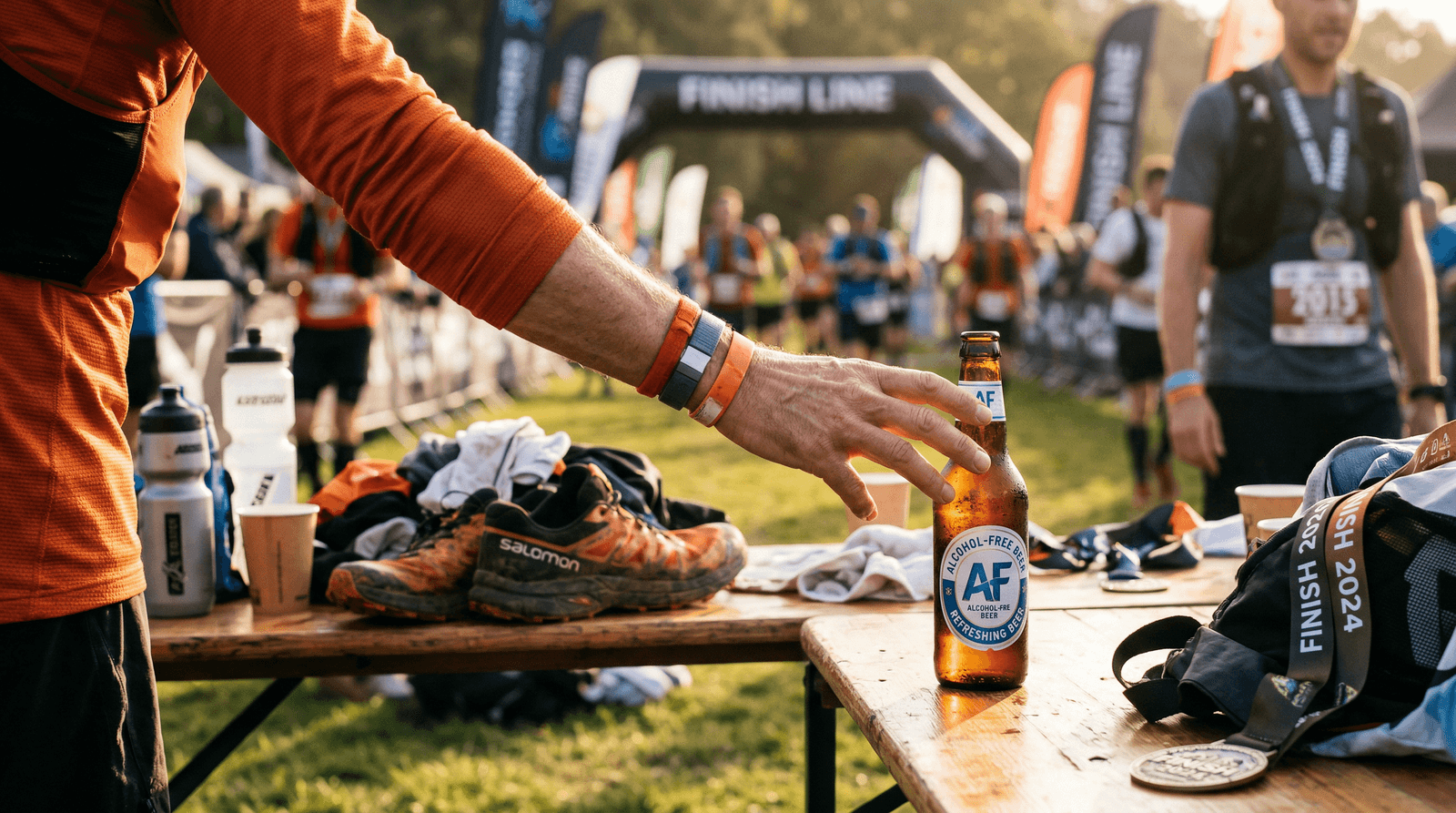
The post-race pint is one of running and cycling culture's most sacred rituals. Except now, plenty of athletes are reaching for alcohol-free beer instead, and there's proper science behind it. This isn't a wellness trend cooked up by marketing departments. German researchers have been studying alcohol-free beer for athletes as a recovery drink for over a decade, and the results are striking.
The point isn't that AF beer is "low-calorie". For runners, cyclists, triathletes and lifters, the carbs in beer are part of why it works after exercise: your glycogen stores have just been emptied. What AF beer adds on top is hydration without alcohol's diuretic effect, polyphenols that quietly damp down post-exercise inflammation, and a familiar social ritual you can step into without sabotaging tomorrow's session.
The Science: Why Alcohol-Free Beer for Athletes Works
- Olympians are using non-alcoholic beer as recovery drinks, NPR (2018)
- Effect of flavonoids on URTI and immune function, Advances in Nutrition 2016
- Erdinger Alkoholfrei non-alcoholic wheat beer, Erdinger
- Alcohol ingestion impairs maximal post-exercise rates of myofibrillar protein synthesis, PLOS ONE 2014
- Post-exercise rehydration with beer, Frontiers in Nutrition 2016
Beer is one of the richest dietary sources of polyphenols, the plant-based compounds with anti-inflammatory and antioxidant properties. The problem with regular beer is that alcohol undermines those benefits. It dehydrates you and impairs muscle protein synthesis, and adds nothing useful to the recovery picture. Strip out the alcohol and you keep all the good stuff.
Many AF wheat beers also retain B vitamins (Erdinger Alkoholfrei, for example, lists B9 and B12), which support energy metabolism and red blood cell production. They contain potassium and sodium, electrolytes your body burns through during exercise. And those polyphenols have antiviral properties, which matters when your immune system is suppressed after a hard effort.
Carbohydrate content of most AF beers sits around 60 to 80 grams per litre (roughly 6 to 8 grams per 100 ml). That's similar territory to purpose-built sports drinks. After a long run or ride, that's a feature, not a bug.
The Recovery Angle: Post-Exercise Performance
- Non-alcoholic beer reduces inflammation and URTI in marathon runners, Med Sci Sports Exerc 2012
- Non-alcoholic wheat beer boosts athletes' health (Be-MaGIC), ScienceDaily 2011
- Effects of beer and non-alcoholic beer on electrolyte homeostasis, Nutrients 2016
- Prof Dr Johannes Scherr profile, Balgrist University Hospital
The landmark study came from Dr Johannes Scherr's group at the Technische Universität München, published in 2012 under the Be-MaGIC programme (Beer, Marathons, Genetics, Inflammation and the Cardiovascular system). It tracked 277 runners around the 2009 Munich Marathon over five weeks. Half drank 1 to 1.5 litres (about 34 to 51 fl oz) of AF wheat beer daily for three weeks before the race and two weeks after. The other half got a placebo.
The AF beer group were 3.25 times less likely to develop upper respiratory tract infections. Their inflammation markers dropped by around 20%. For endurance athletes, who routinely suffer immune suppression after hard training blocks and races, this is a significant finding.
A separate 2016 study in Nutrients found that athletes who drank AF beer 45 minutes before a hard workout kept plasma sodium and potassium stable during exercise. Water alone reduced plasma sodium by around 4%, and alcoholic beer raised potassium by 8.5%. AF beer doesn't trigger the diuretic effect that regular beer does, so you're not losing fluid faster than you're taking it in. Exactly what you want post-effort.
Dr Scherr went on to serve as senior team physician for the German Alpine ski team and as a German Olympic Association physician at Vancouver 2010 and PyeongChang 2018, where he reported that nearly all athletes drink AF beer during training. It's not a fringe practice. It's mainstream in elite endurance sport.
The Calorie Question: It's the Wrong Question
You'll see plenty of "AF beer is lower in calories than a sports drink!" angles online. For most athletes, that framing misses the point twice over.
First, after a long endurance session you've usually just emptied your glycogen stores. Calories from carbs are exactly what recovery needs. A wheat beer like Erdinger Alkoholfrei sitting around 25 kcal per 100 ml is doing useful work, not undermining your training. The carbs are the carbs.
Second, sports drinks aren't actually that high-calorie either. The bigger differentiator is what AF beer adds that sports drinks don't: polyphenols and B vitamins. Sports drinks are formulated for in-session sodium and rapid sugar uptake, useful during a long ride, less essential afterwards. For post-exercise recovery, where you're eating food alongside your drink, AF beer's polyphenol load and isotonic carbohydrate profile do something a typical sports drink can't.
If you're trying to lose weight, drink less of everything. But framing AF beer as "the low-calorie option" sells short what it's actually good for.
Strong Picks for the Post-Exercise Pint
For a wider AF shortlist that isn't sport-specific, see our best AF beers UK roundup. The picks below have the strongest sport-science or endurance-event pedigree (verifiable signals, not editorial taste tests).
Erdinger Alkoholfrei. One of the longest-established isotonic alcohol-free beers. Brewed under the Bavarian Purity Law of 1516 from four natural ingredients, which Erdinger says has isotonic properties produced by its brewing process. Erdinger is a long-standing partner of running and triathlon events internationally; you'll recognise it as the post-race beer at a lot of finish lines.
Athletic Brewing Run Wild IPA / Upside Dawn. Athletic Brewing is the official non-alcoholic beer of the IRONMAN and IRONMAN 70.3 Global Series, with the partnership renewed in October 2025 through the 2028 season. Run Wild is a hop-forward IPA built around five Northwest hops (pine character); Upside Dawn is the easier-drinking golden beer. Both are pitched as everyday training-companion beers rather than occasional treats.
For the social ritual end (the post-parkrun pub round, the after-cycle cafe stop) you're spoiled for choice. Lucky Saint, Days Brewing, BrewDog Nanny State, Big Drop, Lucky Saint Hazy IPA and the supermarket end of Athletic Brewing all do the job. The "best" one is whichever your local pub already pours on draught, because the social half of recovery (the standing-around-talking-about-the-ride part) matters as much as the chemistry.
Practical Recommendations by Sport
Runners: Erdinger Alkoholfrei after a long run is hard to beat: the isotonic carbohydrate profile is built for exactly that moment. For shorter weekday runs, anything goes; the social ritual is the active ingredient.
Cyclists: Cyclists tend to burn the most calories of any endurance group, so AF beer's carb content matters. Erdinger or a wheat-style AF beer after a long ride pairs neatly with a cafe stop.
Triathletes: Athletic Brewing has made this easy for you. They're literally the beer brand at your races. Run Wild or Upside Dawn at the finish line.
Gym and strength training: The anti-inflammatory benefits of polyphenols are relevant for DOMS recovery. A wheat-style or oat-rich AF beer post-session does the polyphenol job and gives you a few useful carbs alongside your protein.
Weekend warriors and parkrunners: Honestly, any AF beer works. The main benefit is that you get the social ritual of a post-exercise drink without the dehydration, sleep disruption and next-day grogginess of alcohol. Your Sunday afternoon will thank you.
The recovery pint has gone alcohol-free, and the science (Munich marathon study, isotonic profile, polyphenol load, no diuretic hit) says your body will be better for it. Whether you're training for a marathon or just trying to make parkrun feel less brutal, alcohol-free beer for recovery is one of the easiest performance upgrades available. No special equipment required. Just a cold one from the fridge.